Nov, 2025
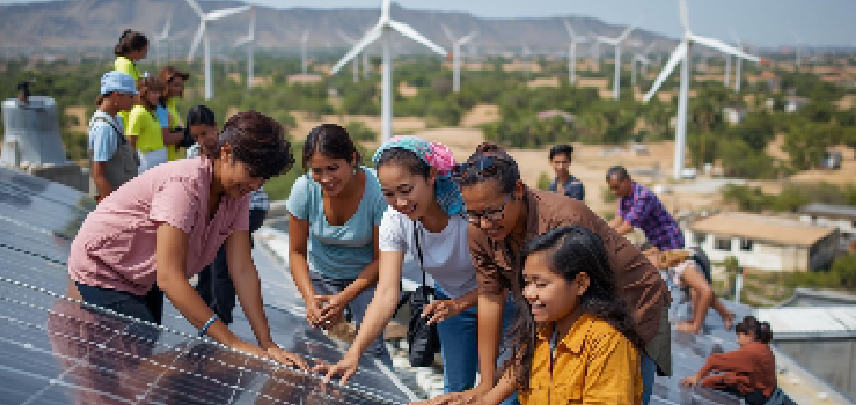
The issue of the disproportionate impact of energy transition on women has long been documented in literature and has featured in international climate negotiations since 2014, following the launch of the Lima Work Programme on Gender[1] during the 20th Conference of Parties (COP 20). These impacts cut across numerous dimensions, one of which concerns employment opportunities. More recently, the commencement of the COP 30 deliberations witnessed the launch of the ‘Global Initiative on Jobs & Skills for the New Economy[2]’, with a focus on augmenting investment in human capital, promoting social inclusion, while also aligning workforce development with countries’ economic and climate goals. This initiative underscores the need to develop solutions that ensure that climate action is not bereft of employment generation, skill augmentation and provision of social protection.
While the clean energy sector bears the potential for employment creation and skill development, women continue to remain underrepresented, particularly in technical and leadership roles.

In the Indian context, an analysis by the McKinsey Global Institute indicates that women represent only 11 percent[3] of the workforce of the country’s renewable energy sector. Similarly, within the segment of energy efficiency (EE), a recent study by ICRIER[4] estimated that EE-relevant employment in the Indian manufacturing sector stood at a meagre 8 percent of the total manufacturing employment in the country in 2022-23. Of this, women comprised a minimal 5.3 percent. It is pertinent to unpack the probable reasons behind this under-representation against the backdrop of India’s fast-paced clean energy transition.
In the EE landscape, there are certain skills that are generally associated with the sector. It is assumed that the sector would employ a greater share of the seemingly low-skilled or elementary occupations. Challenging that pre-conceived notion, ICRIER’s analysis found that the EE manufacturing employment was made up of a dominant share of high skill or senior occupations that either have relatively higher educational attainment or vast experience in the field. In that, within the minimal share of women in EE-relevant employment, it was discovered that majority women were employed in the high skill sector (about 79 percent). Further assessment revealed that about 37 percent of women in EE-relevant employment hold graduate-level or higher qualifications. This in turn suggests that female entry into EE-relevant roles is strongly mediated by formal higher education, not by experience-based pathways. This hints at the fact that the women workforce clearly has the requisite skill requirements.
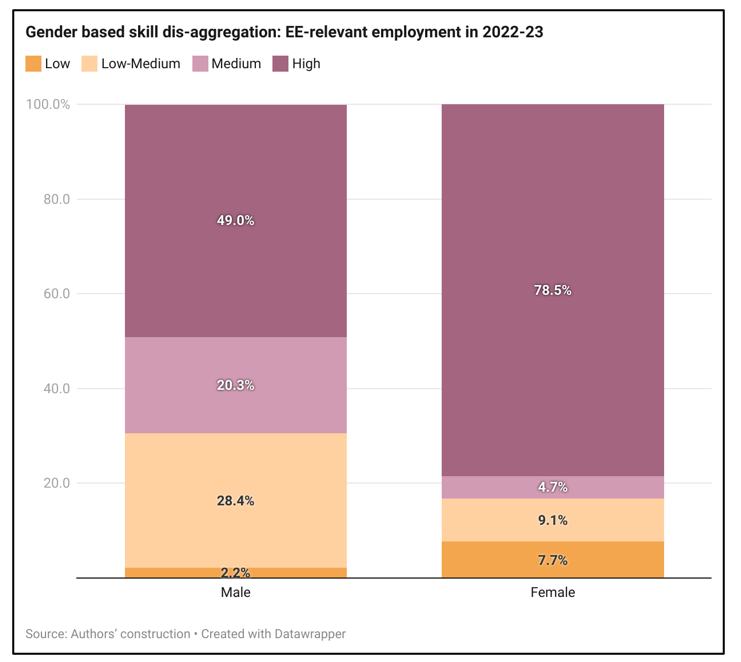
(Source: Authors’ construction)
The educational attainment of women in the EE sector, in fact, showcases an interesting story.
In particular, the data indicated that about 50 per cent of women were educated at primary, middle or below levels. This corroborates the finding that women are also represented in low-skill EE-relevant roles such as informal support functions, ancillary work, clerical assistance, etc. It was observed that the low-skill women's composition was not translating into medium-skill technical upgradation. The data indicate that women are largely absent or underrepresented in the medium-skill technical roles, which form a crucial part of the ‘implementers’ in EE-linked work. In fact, the share of women having any vocational/technical certification was extremely low in EE sector, implying limited participation in technical skilling streams that feed operational and technician-level EE employment. Women's employment in the EE sector thus faces dual polarisation. There is a ‘missing middle’. The middle-range roles are almost exclusively male. The absence of women here then signals structural blockages in the clean energy transition.
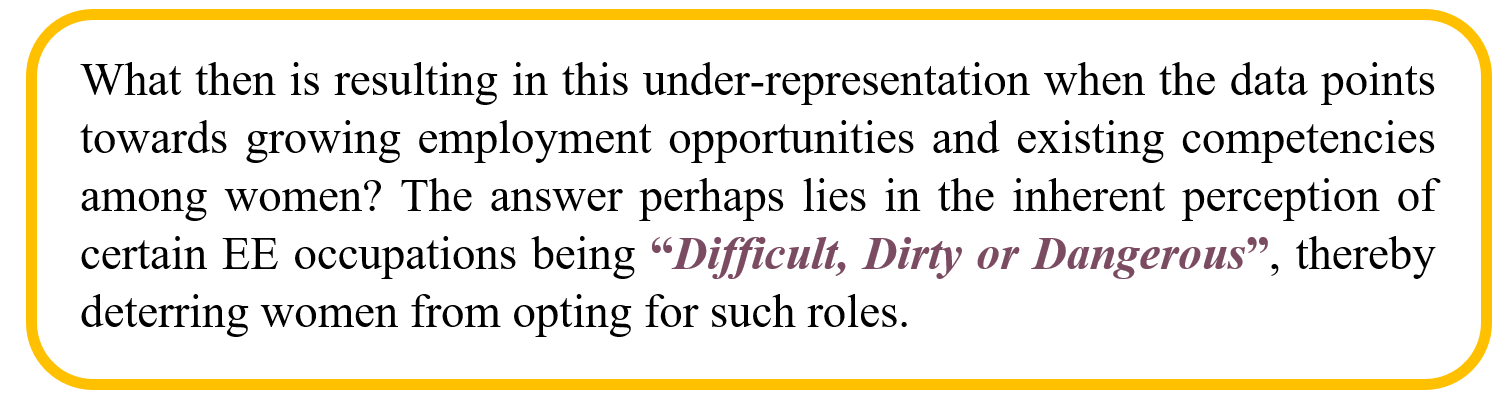
In other words, while they may possess the skill sets and qualifications required to fulfil the responsibilities, there may be other forces at play that influence their choice or contribute to their not entering the field. Based on the ICRIER survey conducted in the states of Tamil Nadu and Gujarat, it was found that women’s enrollment in Industrial Training Institutes (ITIs) remains low. Within the limited availability of EE courses that are otherwise subsumed under renewable energy programs, it was noted that only a handful of women sign up for the basic level training courses. Some of the reasons cited included prevailing gender biases that perceive women as unfit or less capable of handling physically demanding technical work. At the same time, manufacturing firms challenged these claims, highlighting that female workers demonstrate stronger commitment, efficiency, and aptitude in executing tasks once trained.
These findings suggest that as the country continues on the path of clean energy and towards meeting its targets, there is a lot that remains to ensure a holistic and inclusive transition. Gender inclusion remains limited in India’s current clean energy transition. The numbers suggest a striking gender imbalance. It is crucial to comprehend that such transitions, particularly in a developing country, are not only technological but also social. A lot of factors play a part and carry the potential to influence lives. India cannot have a just, clean transition without systematically building pathways for women to participate, from training to hiring to advancement in skills.
There is a need to address the existing structural barriers in training and hiring of women and reduce to eventually remove the misalignment between capability and opportunity. Focus needs to be drawn towards the expansion of EE-specific courses. In addition, to increase the female composition of the employed workforce, there is an urgent need to ensure that the workplace as a whole is made more conducive for gender inclusivity. This will require coverage across the setup and not simple pockets or components. From amenable work shift timings to improved and safe sanitation amenities on the premises, child day care facilities and much more. If the ‘difficulty’ in the 3Ds is not the main reason to restrict women's participation, then the other two, i.e., the ‘dirty’ and the ‘dangerous’ need to be addressed. In fact, a simple creation of exclusive technical and supervisory training for women will help to encourage vocational training uptake. Women are not simple beneficiaries of the clean energy transition but contribute to it. Evidence shows that they excel when given an opportunity. The challenge is less about competence and more about access, structure and bias that exist in the sector and communities.
[1] https://energyalliance.org/gender-empowerment-in-the-renewable-energy-sector/
[2] https://icrier.org/pdf/Estimating-Skilling-Needs-and-Filling-Skill-gaps-for-India-Industrial-Energy-Efficiency.pdf
[3] https://www4.unfccc.int/sites/NWPStaging/Pages/Lima-Work-Programme-on-Gender.aspx
[4] https://www.wri.org/news/release-global-leaders-unite-put-jobs-and-skills-center-new-economy-cop30