Oct, 2025

This August, when Gita Gopinath — an Indian-born, female macroeconomist — stepped down from her role as Deputy Managing Director at the International Monetary Fund (IMF), it marked the end of an exceptional chapter for women in global economic policymaking. During successive global crises, Gopinath’s presence as Chief Economist at the IMF was valued not just for her intellectual contributions but also for its symbolism. Her leadership demonstrated that women can, and must, be at the helm of the world’s most consequential economic decisions. Yet, her visibility remains an exception rather than the norm, both in India and globally. At a time when the global economy is navigating constant turbulence, it is imperative to ensure diversity in economic thinking.
Macroeconomists are central to policymaking because they offer evidence-based guidance that enables institutions to craft strategies for growth, stability, and equity. They translate complex datasets into actionable insights on interest rates, taxation, spending priorities, and crisis responses. They assess policy impacts on inequality, poverty, and gender to promote inclusive growth. However, this critical sphere remains dominated by men.
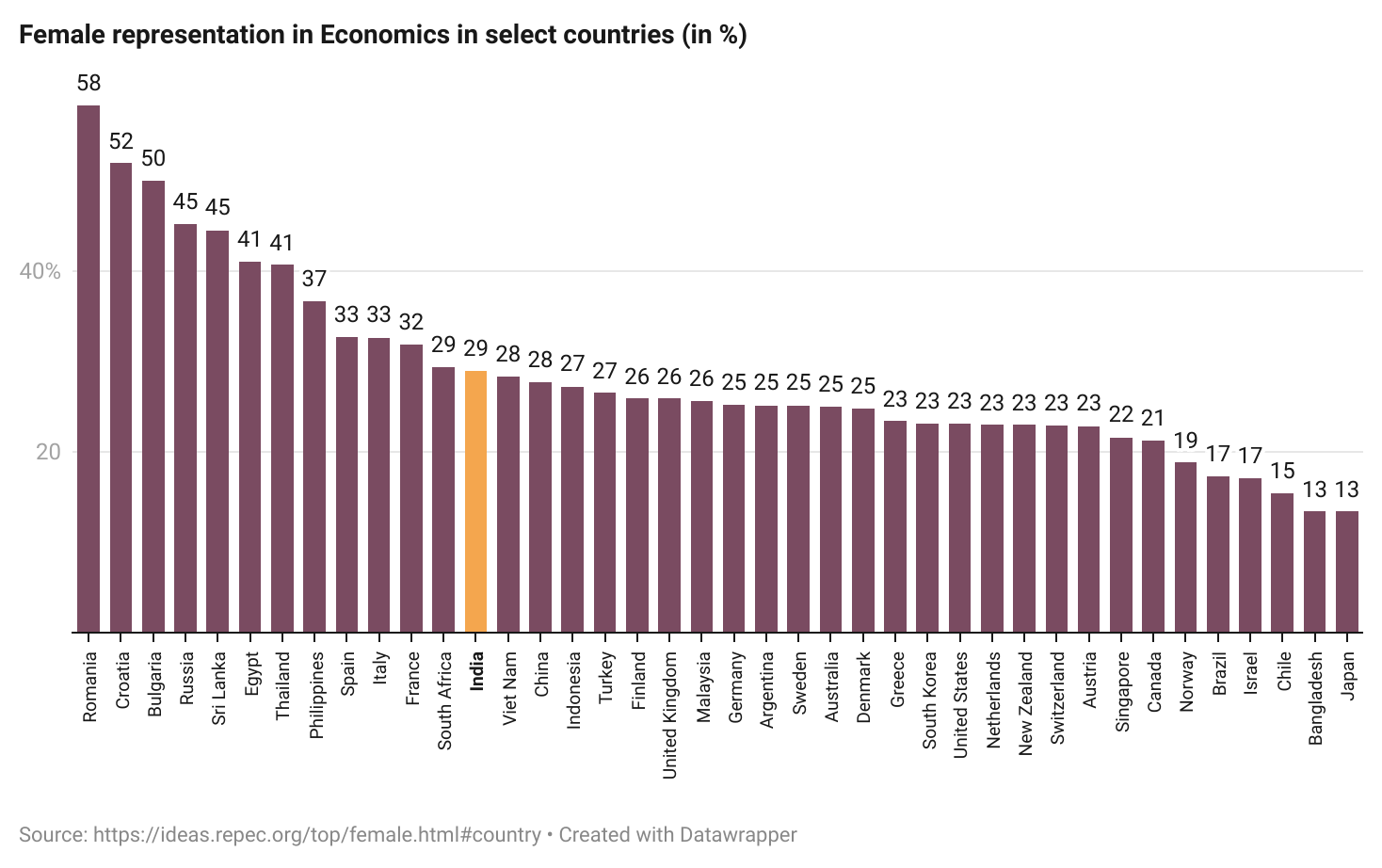
Globally, women are underrepresented in economics, particularly in the fields that shape macroeconomic policy. According to the IDEAS/RePEc database, only 26.7% of registered economists worldwide are women as of August 2025. Eastern European countries lead in representation — Romania (58.3%), Croatia (51.9%), and Bulgaria (50%), while India stands at 28.9%, slightly better than many developed economies. Surprisingly, the United States lags at 23.1%, despite having the largest number of economists.
Gender-Stereotyping in Field Segmentation
The bigger imbalance lies not just in numbers, but where women are concentrated within economics. Women economists cluster disproportionately in certain subfields such as gender economics (53.9%), demographic economics (43.5%), and cultural economics (37.9%). They are strikingly absent from core quantitative and policy-relevant areas such as finance (13.2%), econometrics (15%), microeconomics (14%), and macroeconomics (19.3%) — the very domains that dominate policymaking on economic growth, inflation, fiscal strategies, capital flows, debt and global trade.
This matters because macroeconomic policy is not gender-neutral. Policies designed without considering gendered impacts can fail to serve half the population effectively. Moreover, research consistently shows that diverse teams make better, more innovative decisions.
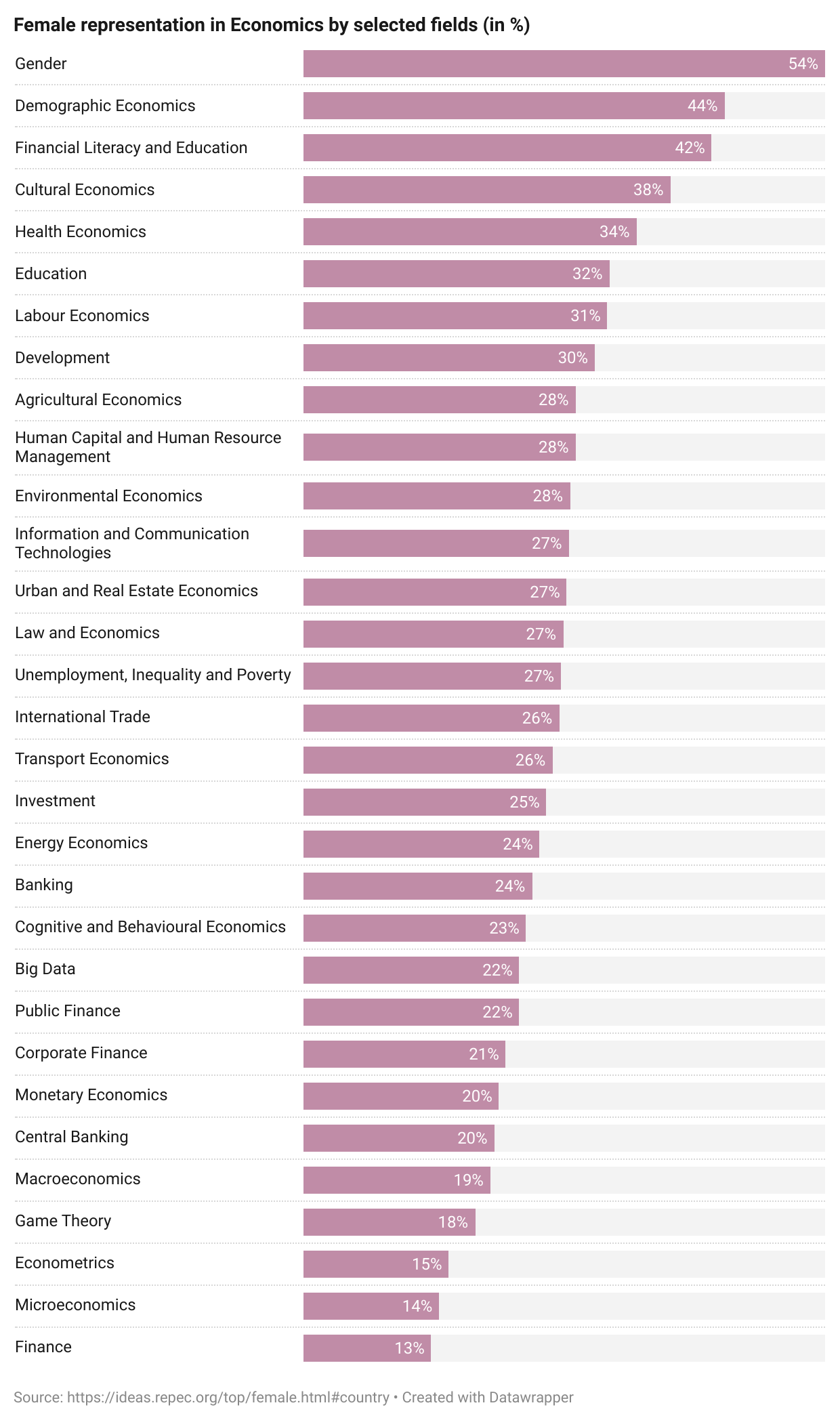
They shape jobs, prices, fiscal allocations, and welfare schemes in ways that affect men and women differently. Without women’s voices at the table, these nuances are often overlooked, leading to policies that fail to serve half the population effectively. Moreover, substantial evidence shows that diverse teams make better, more innovative decisions. By marginalising women, economies forfeit insights essential to inclusive and sustainable growth.
The roots of this underrepresentation are both structural and cultural. Women face the dual pressures of societal expectations around caregiving and institutional barriers such as opaque hiring, biased promotions, and exclusion from elite professional networks. Academic and policymaking environments, meanwhile, often remain indifferent or even hostile to women’s career progression, reinforcing the cycle of underrepresentation
The Indian Context
India also illustrates a leaky pipeline in economics. According to the All-India Survey of Higher Education, women constitute nearly 60% of Master’s and MPhil students and about half of PhD candidates in economics. Yet they account for only about 35% of university faculty positions, with representation falling sharply at senior levels (recent research by Dongre and others). The Prime Minister’s Economic Advisory Council has only two women among its fifteen members. Women held just 8% of senior leadership positions at the Reserve Bank of India (RBI), compared to the 32% average across central banks worldwide (OMFIF Gender Balance Index, 2025) – although this would have changed after RBI appointed its fourth-ever female Deputy Governor.
Nevertheless, there are encouraging signals. India’s Finance Ministry has been helmed by a female economist for half a decade. Women now make up 42.8% of the Indian Economic Service cadre. Several private-sector banks have female chief economists.
Yet these successes remain fragile, dependent on individual breakthroughs, and lack systemic reinforcement.
Pathways for Change
To address both demand-side and supply-side barriers to women’s participation in macroeconomic policymaking, India can pursue several strategies:
◉ Dedicated Mentorship and Networking Programs- Inspired by the U.S. Federal Reserve’s Centre for Advancing Women in Economics (AWE), the RBI and Finance Ministry could create mentorship and research initiatives tailored to women economists. These programs could provide career guidance, facilitate visibility, and promote specialisation in macroeconomic and monetary policy. A national women economists’ network could also be established, drawing from models like Australia’s government-backed Women in Economics Network (WEN).
◉ Targeted Scholarships and Fellowships-Following the European Central Bank (ECB) model, India could introduce scholarships for women studying postgraduate and doctoral economics, particularly in quantitative and policy-focused fields.
◉ Promoting Visibility of Women Economists’ Work - Role models matter greatly. Institutions and media outlets should spotlight women economists’ research year-round, not just around Women’s Day. Platforms like the IMF’s Finance & Development magazine can serve as inspiration.
◉ Inclusive Policy Institutions - With the 33% reservation for women in Parliament now mandated, similar inclusion policies should be adopted in economic institutions. Recruitment targets, flexible work arrangements, family-friendly policies, caregiving support, and leadership development programs can help sustain women’s participation and advancement.
In conclusion, advancing women’s representation in macroeconomic policymaking is critical for equitable and sustainable growth. It requires deliberate, systemic action — from nurturing the talent pipeline to reshaping institutional cultures.