Apr, 2025
Certain crimes leave an indelible scar on our collective conscience, shaking the very foundations of our humanity. Among them, brutal crimes against women stand as a stark and unforgiving measure of a society’s progress—or lack thereof. In India, where the status of women remains a pressing concern, the nation ranks a dismal 128th out of 177 countries in the 2023 Women, Peace, and Security Index. Even more alarming, reported crimes against women surged by 4% between 2021-22 and 2022-23, underscoring a crisis that demands urgent and unwavering attention.
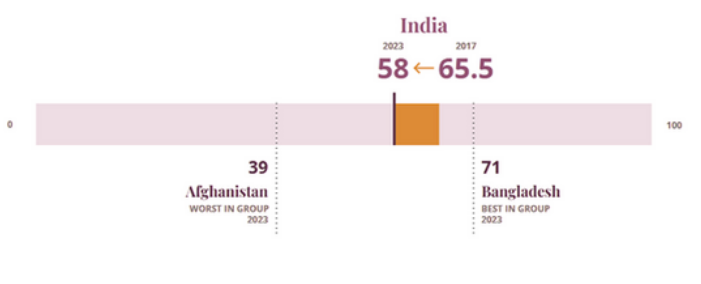
Women's Perception of Community Safety (%)
Security and safety in the community affect women’s mobility and opportunities outside the home. Perceptions of safety are heavily influenced by larger trends of conflict and violence, which threaten women’s immediate and long-term well being. Our Index captures the percentage of women ages 15 years and older who report that they “feel safe walking alone at night in the city or area where you live.”
Source: Gallup World Poll
Image Source: https://giwps.georgetown.edu/country/india/
The brutal rape and murder of a postgraduate trainee doctor at a government hospital in Kolkata on August 9, 2024, is a grim reminder of the persistent safety crisis for women in India. While the Sealdah Sessions Court convicted the accused, sentencing him to life imprisonment on January 20, 2025, justice alone does not address the larger issue—how safe are our cities and workplaces for women?
The recent tragedy, unfolding in a hospital—both a public space and a workplace—highlights the systemic failure in ensuring women’s security. In response to public outrage, the West Bengal government introduced the Rattirer Saathi program, aimed at improving workplace safety through measures like women-only rest areas, safety apps, and CCTV monitoring. However, the Supreme Court objected to provisions limiting women’s working hours, citing gender discrimination. The real challenge remains: can safety reforms be implemented without restricting women’s rights and opportunities?
There is a crucial distinction between protection and security. Protection assumes vulnerability, imposing guardianship and limiting autonomy—suitable for children but not for empowered adults. Security, by contrast, fosters safe environments through well-lit streets, alarm systems, and robust public infrastructure, enabling individuals to safeguard themselves. True safety requires strong public transport, last-mile connectivity, and well-planned urban spaces—not restrictive guardianship.
West Bengal’s order adopts a protectionist stance, mandating safety volunteers, 12-hour work limits, and discouraging night shifts for female doctors. While well-intentioned, these measures reinforce patriarchal control rather than enhancing security. The order includes provisions for toilets and drinking water but lacks essential infrastructure audits, improved lighting, and comprehensive security planning. Its reliance on CCTV cameras is flawed, while useful for post-crime identification, they do little to prevent violence in real time. Worse, constant surveillance can feel intrusive, replacing societal scrutiny with technological oversight.
Workplace safety is essential, but restricting women’s professional agency in the name of protection is counterproductive. True, security demands systemic reforms—well-lit campuses, accountable public infrastructure, and policies that empower rather than confine. Women need freedom, not restrictions disguised as safety measures.
Financial independence, alongside education, is central to women’s empowerment. Access to schools, colleges, and employment must go beyond practical gender needs to drive true transformation. However, many policies still take a protectionist approach, viewing a woman’s earnings as merely enhancing her role within the family, rather than as a means of individual agency.
The recent sexual assault case at Anna University in December 2024, reignited debates on “protection” versus systemic reform. Instead of restricting women’s choices, the focus must be on building safer environments that empower rather than confine.
Many women hesitate to report harassment or assault due to fear of disbelief and societal backlash, leading to restrictive policies like those in West Bengal. Underreporting skews crime data, hindering effective security planning. Public safety, especially at night, is a collective responsibility and not just a government mandate. Urban anonymity fosters bystander apathy, unlike rural communities where social ties encourage intervention. Shifting this mindset requires sustained public engagement.
Mass media plays a pivotal role in reshaping societal attitudes toward women’s safety. Celebrities like Akshay Kumar have successfully fronted public health campaigns, demonstrating the power of consistent and culturally relevant messaging. Television, cinema, and social media must actively address bystander apathy, just as they do for public health. Campaigns should encourage small yet meaningful actions, from reporting suspicious behavior to forming neighborhood watch groups.
True safety does not come from restrictions but from enabling environments. The difference between protection and security is critical. A holistic approach demands collaboration between the government, civil society, and the private sector to create a secure yet enabling environment. Improving street lighting, ensuring accessible and affordable transport, and integrating women into the app-based mobility workforce are tangible steps forward. Encouraging more women drivers for cabs, auto rickshaws and bike taxis could bridge last-mile connectivity gaps, making travel at all hours safer and more inclusive. When mobility is safe, women are free to pursue opportunities without hesitation— because true security is not about limiting movement, but about empowering it.
About the Authors
Meera Sundararajan is a Gender and M&E Expert, formerly working as Team lead at the Gender and Policy Lab established by the Greater Chennai Corporation with the objective of addressing women’s safety and mobility issues.
Madhumitha V works as the LeadCentre for Future Mobility at the Ola Mobility Institute Foundation