Mar, 2025
Isn’t Being a Woman Enough to Access the “Privilege” of Financial Literacy?
A Tale as Old as Time
The portrayal of women in Indian society has been complex, swinging between reverence and restriction. Ancient mythology depicted women as embodiments of wisdom and power, yet societal practices often contradicted these ideals. Goddesses like Saraswati (symbolizing knowledge) and Lakshmi (symbolizing wealth) prove that both the deities knew where to invest their money and brains. Yet, in practice, caregiving roles often took precedence over economic participation.
Many would question whether women should “be accommodated” – are we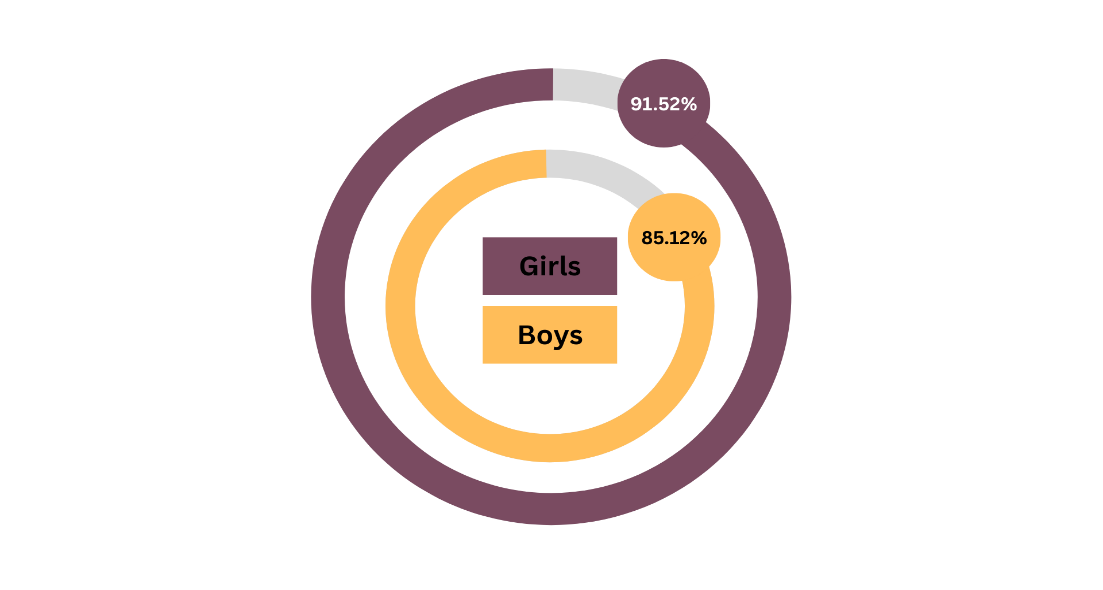 still living in a world where a certain gender is accommodated while talent is overlooked? The ask for cerebral equality is often misquoted as a demand for special rights over the “gender in majority”. The real question is not whether women deserve a seat at the table of financial literacy and leadership, but why, despite their proven competence, they are still struggling to enter the room. Consider the academic performance of young women. Year after year, girls excelled in board exams. In a purely meritocratic world this should translate into equal opportunities, financial education, and financial independence. But does it?
Two Realities, One Challenge
Women’s financial literacy falls into two realities: those with education and careers who still struggle with financial independence, and those denied both, facing even greater barriers. This piece focuses on the former—women who have broken academic and professional ceilings yet remain uncertain in financial decision-making. This article is not written to deepen the divide between men and women, but to shed light on a shared challenge that, when addressed collectively, strengthens us as a society. Their struggle is one we’ve seen, lived, and can speak to authentically. More importantly, they are the ones who can access this discussion. In our next edition, we’ll explore the challenges of women without formal education or career opportunities and ways to empower them.
Introduction: Proposing a Vision for Tomorrow’s Leaders
“Men and women are not adversaries in the fight for progress; they are allies.” Together, we face systemic inequities and structural barriers, one of which is financial illiteracy – a critical hurdle holding back the potential of millions of women in India.
In a country as diverse and dynamic as India, the ability to manage finances should be a universal right, not a privilege reserved for the few. Yet, millions of women remain excluded from the world of financial literacy, trapped in a cycle of dependency and vulnerability. While India has made significant strides in promoting gender equality in education and employment, the financial knowledge gap persists, hindering true empowerment. The lack of financial literacy among women is more than a statistic; it is a deeply human story of lost potential.
A Turn of Events: Progress, Yet Miles to Go
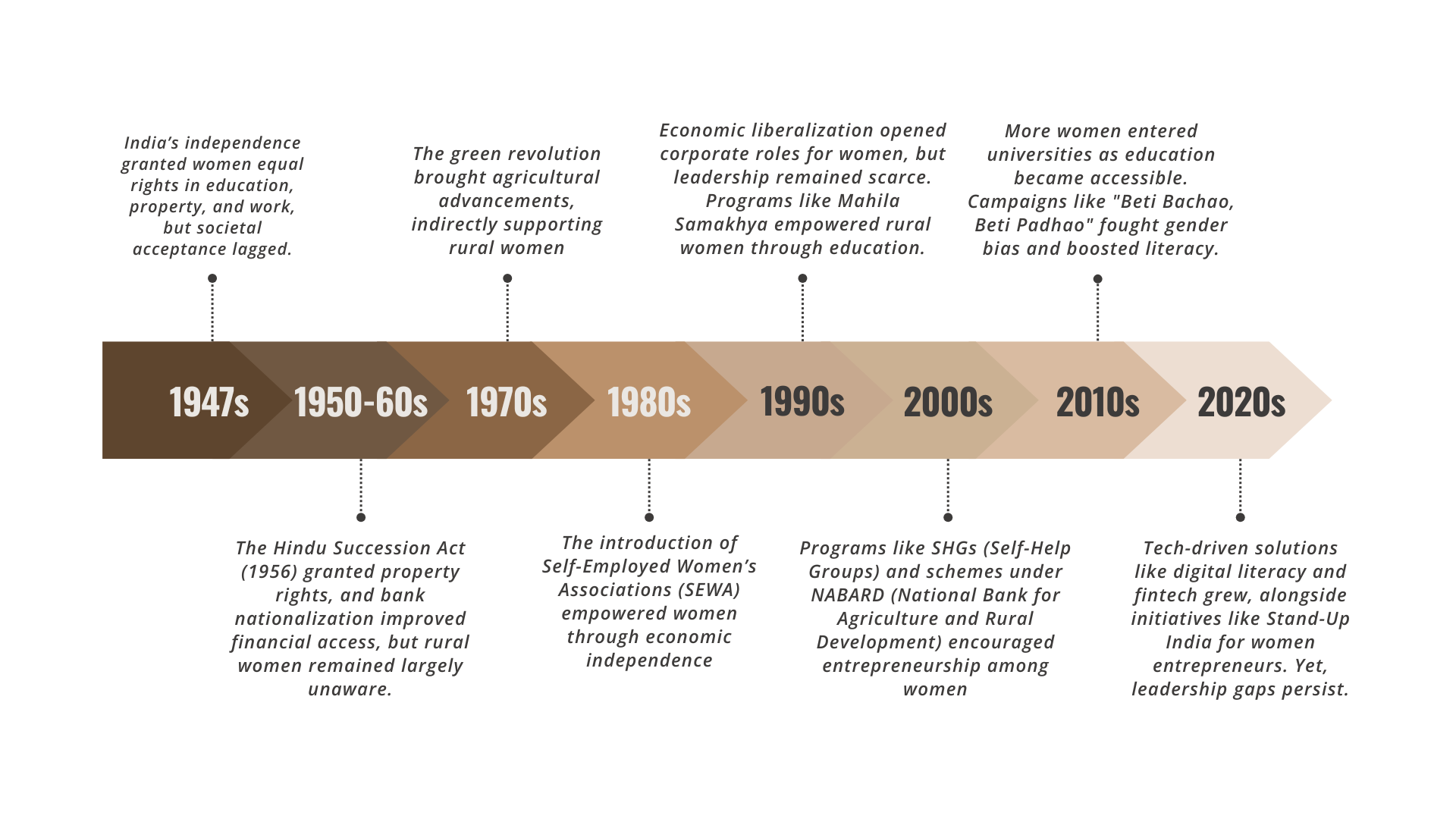
Today, India celebrates women’s empowerment as a story of resilience and transformation. Let’s trace this turn of events – a timeline of milestones that signify how far we’ve come and the journey that remains.
Figure 2: The Journey of Indian Women towards Financial Literacy
Financial Literacy: More Important Than Ever Today
As the financial landscape becomes increasingly complex, financial literacy is vital for women to navigate challenges, build wealth, and secure independence. It is not enough to access banking; women must be equipped with knowledge to make informed, strategic decisions for long-term success and empowering their own families.
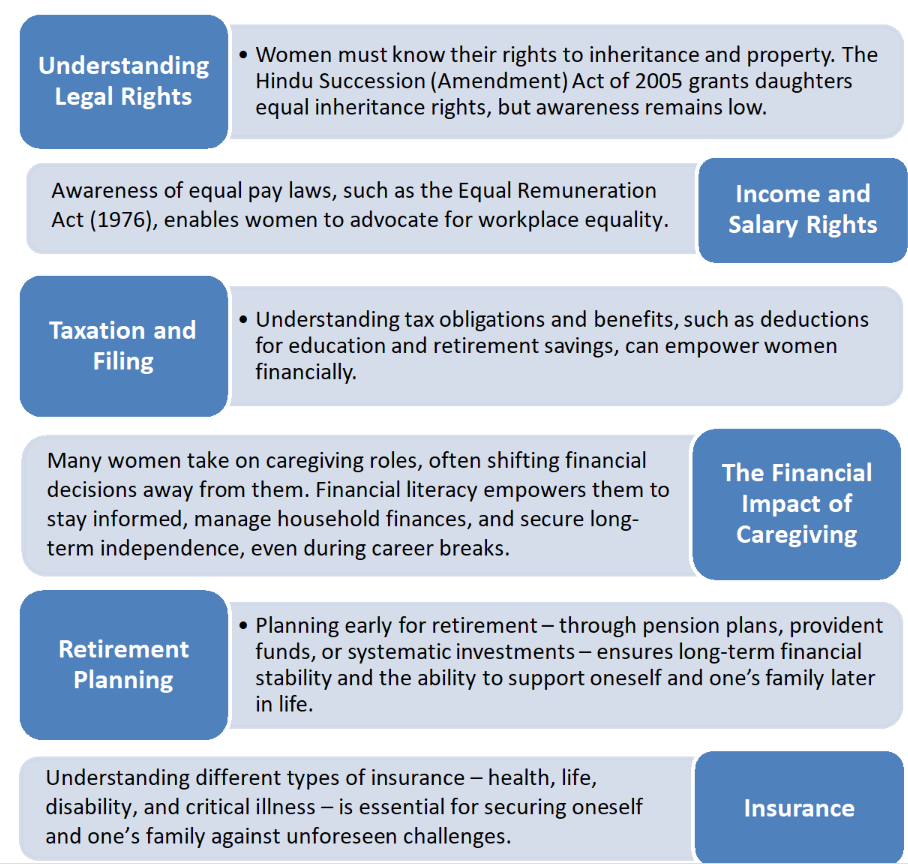
Financial literacy encompasses budgeting, saving, investing, and understanding taxes and insurance. It enables women to achieve financial stability – living within means and securing their future – and independence, empowering them to make decisions aligned with their goals.
What Else is Included Under Financial Literacy?
Let the Numbers do the Talking
The S&P Global FinLit Survey states that worldwide, 30% of women are financially literate . In India, the situation is even more pronounced, with only 21% of women deemed financially literate, according to a 2020-21 National Centre for Financial Education (NCFE) survey3.
Corroborating the aforementioned, data from the Humanity Welfare Council also reconfirms that 80% of Indian women struggle with financial literacy, highlighting the critical need for targeted interventions4.
Access to financial systems is another significant challenge. About 62% of Indian women do not own bank accounts or have limited access to banking services5, emphasizing the barriers many face in achieving financial independence. Educated women in urban areas fare better but are still underrepresented in advanced financial decision-making.
So, what's in my bag? A Repository for Women Seeking Financial Literacy in India
In India, understanding key laws and financial products is essential for ensuring economic independence and security. We have tried to capture a few to get the ball rolling for the readers:
1. Tax Benefits and Financial Schemes
2. Women Entrepreneurs’ Rights
3. Social Security and Pension
4. Legal Protections Against Discrimination
5. Insurance and Health Benefits
6. Property Rights and Inheritance
Solutions to Address Financial Literacy Disparities
The gap in financial literacy among women is not just a social issue; it is a systemic challenge that limits economic growth and individual empowerment. For women to claim their rightful place in decision-making, whether in households, businesses, or the boardroom, equipping them with financial knowledge is essential. Addressing this requires a multifaceted approach involving all stakeholders, including industry leaders, policymakers, and civil society.
What can we do?
1. Awareness Programs and Ecosystem Engagement:
2. Research Studies to Uncover Deeper Insights:
3. Industry Dialogues and High-Impact Sessions:
4. Policy Advocacy:
By fostering collaboration, enabling research, and engaging with influential stakeholders, every Indian can ensure that financial literacy is no longer a privilege but a right accessible to every woman in India. The truth is – financial literacy isn’t just for the boardroom, it’s for the living room, the kitchen table, and every single woman who has ever been told money matters aren’t for her. Now, ask yourself: Are you ready to let her carry her own purse?