Jan, 2026
Wildlife photography in India is a niche but influential creative profession that sits at the intersection of conservation, media and the gig economy. Characterised by freelance work, extended periods of travel, irregular income, and physical presence in remote and male-dominated environments, wildlife photography has largely been inaccessible to women. Only recently have women begun to gain a foothold within the profession. And, for most women, entry into this field has required overcoming structural barriers, ranging from safety concerns and mobility constraints to informal gatekeeping in conservation and media networks. However, just as women’s participation has begun to grow, the rapid spread of generative artificial intelligence (AI) threatens to destabilise this fragile progress, reshaping who gets visibility, credibility, and income in wildlife storytelling.
Wildlife photography in India is an economically relevant conservation-linked profession where women remain under-represented
India is home to one of the world’s largest networks of protected areas, with over 100 national parks and more than 560 wildlife sanctuaries spread across diverse ecological zones. Wildlife-related tourism, conservation communication, and biodiversity documentation, therefore, form a small but significant part of India’s environmental economy. This relevance has been reinforced by recent policy discourse, including the Prime Minister’s “People and Planet” mission, which emphasises sustainable development, conservation-led growth and community engagement in environmental stewardship.
Wildlife photography occupies a critical yet often overlooked economic and cultural significance. Beyond its artistic value, it plays a crucial role in conservation awareness, scientific documentation, and livelihood generation for gig-based photographers. However, recent advances in generative AI have now made it possible to produce highly realistic images of animals and landscapes within seconds, many of which are often indistinguishable from field-based photographs. This shift has serious implications for professional credibility and market demand, particularly in India, where wildlife imagery frequently intersects with sensitive issues of human-wildlife conflict.
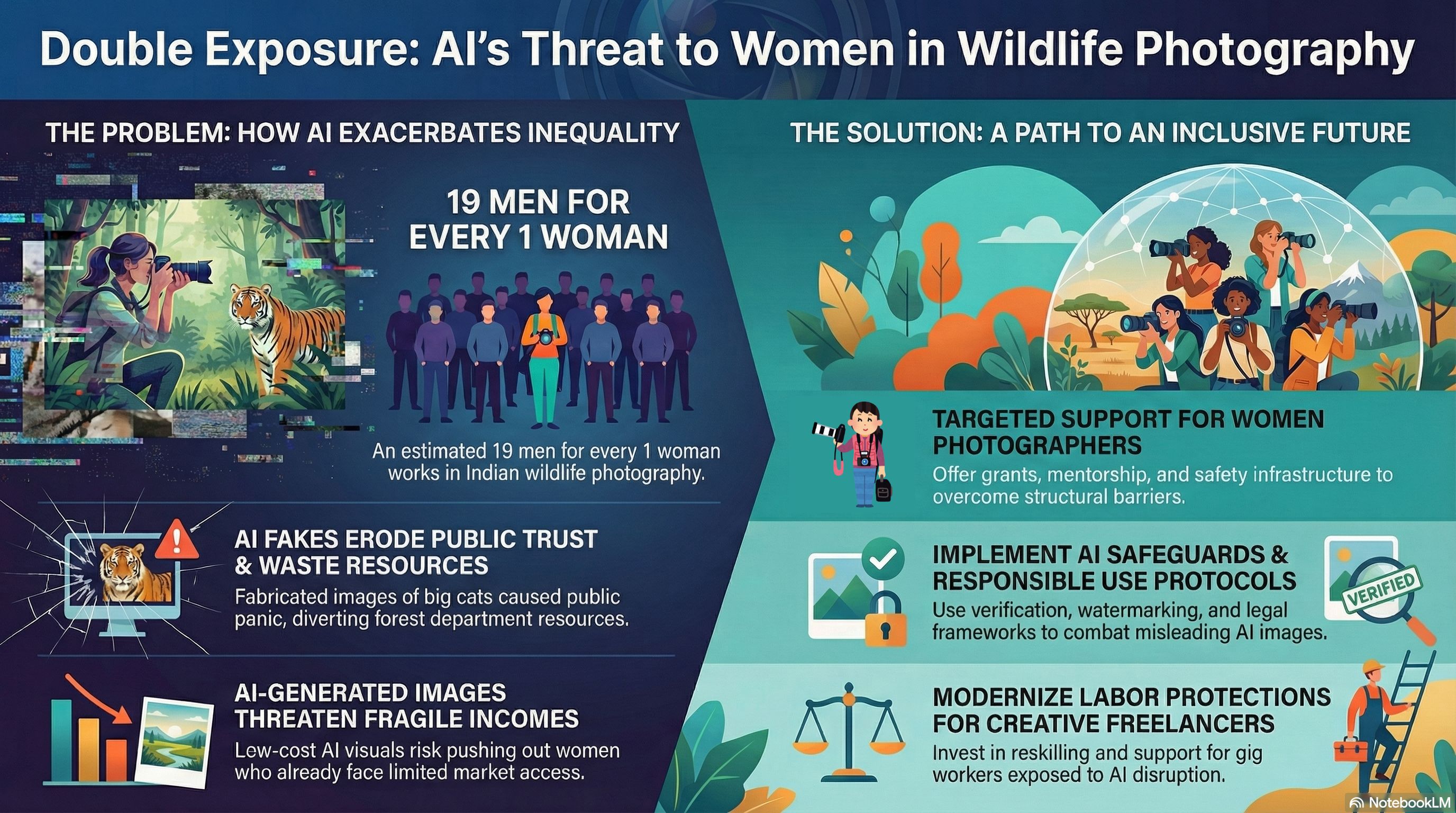
For instance, in late 2025, the Pune Forest Department issued a public warning against the circulation of AI-generated images depicting tigers and leopards on social media platforms, as one widely shared fabricated image led residents to believe that a leopard had been sighted near the Bavdhan area, prompting multiple unnecessary panic calls to forest officials. A similar incident occurred in Coimbatore, where an AI-generated image of a leopard went viral, leading residents to believe that a ‘big cat’ had entered residential neighbourhoods. Forest officials were again forced to intervene, clarifying that the image was false.
These incidents highlight how AI-generated wildlife imagery can not only divert limited forest department resources and heighten public anxiety but also undermine trust in legitimate wildlife photography and reporting, posing a direct challenge to conservation governance in India.
Generative AI is reshaping wildlife photography in ways that intensify existing gender and livelihood inequalities
While the visibility of female wildlife photographers in India has increased gradually, the profession remains overwhelmingly male-dominated. As reported by Harper’s Bazaar India, the gender ratio in wildlife photography has been informally estimated at approximately 19 men for every woman. Women photographers reported persistent challenges, including sexism, restricted mobility, safety concerns during fieldwork and the tendency to treat their presence as exceptional rather than professional.
These barriers are not merely social but economic. Wildlife photography often requires significant upfront investment in equipment, travel and unpaid field time, with uncertain returns. For women, these costs are compounded by additional safety-related expenses, limited access to informal mentorship networks and fewer opportunities for long-term assignments. As a result, women are more likely to exit the field early or struggle to transition from hobbyist to professional roles.
The rapid diffusion of generative AI introduces a new layer of precarity. On the surface, AI tools could reduce certain entry barriers by lowering dependence on expensive equipment or extensive travel. Analytical platforms such as wildlife image databases and AI-assisted sorting tools may also support conservation-related research. AI-based gig platforms could enable matching professional wildlife photographers to remote earning opportunities.
Yet these benefits coexist with significant threats. AI-generated imagery risks saturating an already narrow market for wildlife photographs. As media outlets, advertisers, and digital platforms increasingly opt for low-cost, AI-generated visuals, competition intensifies. For women who already face fragile market access and limited professional security, this shift may disproportionately undermine income opportunities and long-term career viability.
Moreover, global projections suggest that up to 92 million jobs could be displaced by AI by 2030, with creative freelancers among the most exposed. In a sector where women are under-represented and over-exposed to risk, AI-driven disruption may deepen gender gaps rather than close them.
A gender-inclusive policy approach is required to protect creative livelihoods while governing AI responsibly
The task ahead is not to reject AI, but to govern it thoughtfully. The following are some suggested measures that various stakeholders can implement to sustain wildlife photography and to ensure a gender inclusive future for the profession in an AI-disrupted world:
Targeted Economic Support: Public institutions, conservation organisations and media platforms should expand grants, fellowships and long-term documentation projects that prioritise field-based wildlife photography and explicitly include women beneficiaries.
Safety and Mobility Infrastructure: Support mechanisms must account for travel safety, accommodation and logistical assistance for women photographers. Without addressing these structural constraints, increased participation will remain limited.
Mentorship and Professional Visibility: Structured mentorship programmes, exhibitions and editorial platforms focused on women wildlife photographers can help counter gender bias, build professional networks and showcase role models to normalise women’s presence in the field.
Gender-Focused Professional Upskilling: Targeted upskilling initiatives are needed to support women in wildlife photography, through training in field techniques, conservation literacy, business skills and professional networking. Such programmes can improve career sustainability, reduce early exit and address structural barriers that limit women’s participation in the field.
Implement AI Safeguards and Promote Responsible Use: Wildlife images circulated online, especially those reporting animal sightings, should be subject to metadata verification, digital watermarking and platform-level authenticity indicators, developed in collaboration with forest departments and technology firms. The circulation of fabricated wildlife images that trigger public panic should be addressed under existing provisions of the Information Technology Act, supported by clear national guidelines.AI applications should be encouraged for legitimate conservation uses such as camera-trap analysis, species identification and monitoring illegal activities, while discouraging deceptive or misleading practices.
Protect Freelance Work: Freelancers are disproportionately exposed to the disruptions caused by generative AI, while existing labour frameworks remain ill-equipped to support non-traditional workers. To ensure that AI adoption delivers long-term and inclusive benefits, policymakers must invest in reskilling initiatives, modernise labour protections, and build institutions that enable meaningful human-AI complementarity in the rapidly evolving labour market.
Conclusion
AI’s growing influence on wildlife photography represents a pivotal moment for the profession. While the technology offers new creative and analytical possibilities, it also threatens to erode trust in visual evidence and destabilise a field already marked by financial uncertainty. In India, where wildlife imagery has direct consequences for conservation, public safety and community relations, the stakes are particularly high. By embedding gender inclusion, authenticity, and conservation ethics into policy and platform design, India can ensure that technological innovation strengthens rather than silences the voices documenting its wild spaces.
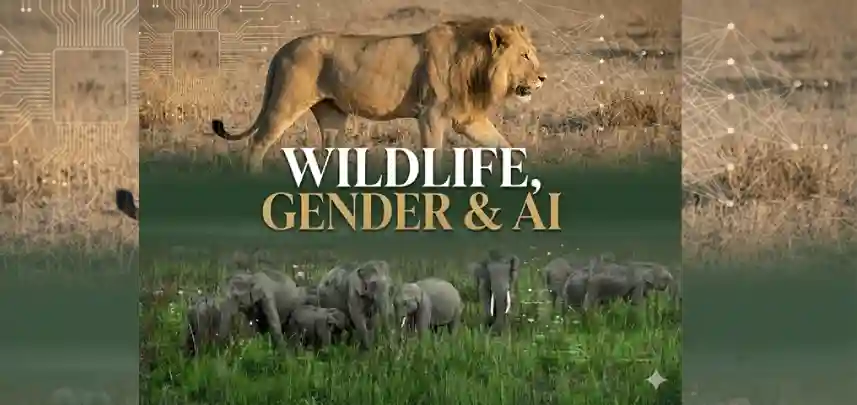
The thumbnail image illustrates the blurring line between reality and artificial creation—the first image is AI-generated, while the second is a real photograph of elephants in Kaziranga National Park by Abeer Srivastava.
References
• Forest dept warns against circulating AI-generated wildlife images, The Times of India, Dec 2025.
• AI-generated image of leopard goes viral in Coimbatore; forest department warns against spreading rumours, The Times of India, Dec 2025.
• Photo of ‘tiger’ in Junnar was AI-generated, finds forest dept probe; officials warn of action, The Indian Express, Nov 2025.
• What Does Generative AI Mean for Bird and Nature Photography? Audubon Magazine (Allen Murabayashi), Summer 2023.
• 92 million jobs will be lost by 2030… What does AI mean for your photography career? Digital Camera World, 2025.
• 5 female wildlife photographers share their experiences of battling sexism, Harper’s Bazaar India, Apr 2023.
• Will A.I. Art Disrupt the Wildlife Photography Industry? The Biodiversity Group, 2023.
• AI is Ruining Nature Photography on Facebook, PetaPixel, 2025.
• Is generative AI a job killer? Evidence from the freelance market, Brookings, 2025