May, 2026

The Economic Costs of a Compounded Motherhood Penalty
Shravani Prakash, Cledwyn Fernandez and Anjhana Ramesh
“Motherhood penalty” is a term that economists coined nearly thirty years ago to describe the wage and career setback women face after having children. The phrase was meant to identify a correctable problem that is solvable through childcare, parental leave, flexible work, and social change. Instead, it persists as a penalty that pushes women out of paid work, increases unpaid labour, and depresses earnings and career growth long after childbirth.
India’s large-scale datasets, including the Periodic Labour Force Survey (PLFS) and Time Use Survey (TUS) show how this penalty accumulates through women leaving the workforce, unpaid care work excluded from GDP, and widening gaps in careers and wages over time. It then moves from penalising just women to become a long-term economic trap for the entire economy, one that must be expeditiously addressed.
Married women leave the workforce or earn less, but the men thrive
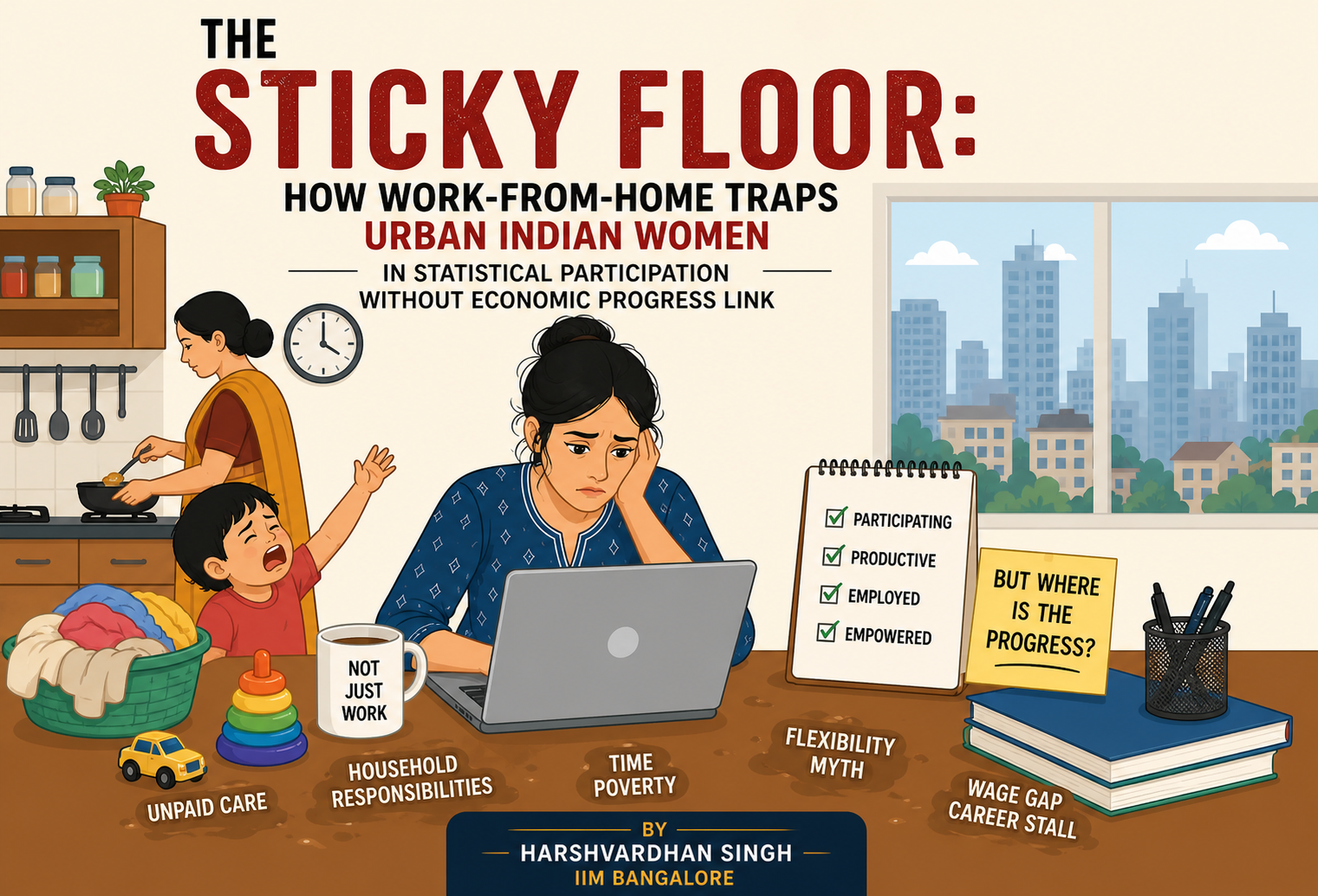
According to PLFS, the rise in India’s female labour force participation rate to above 40% in 2025, masks a sharp divide by marital and parental status. The combined burden of paid work, domestic labour, and caregiving continues to create a “sticky floor” that pushes many women out of the workforce.
Among those aged 25-49, married women’s workforce participation rate is 50% lower than the female average, while married men’s participation is 98%, higher than the male average. Nearly 50% of married women in this age group, or 100.6 million women, are outside the labour force [Figure 1].
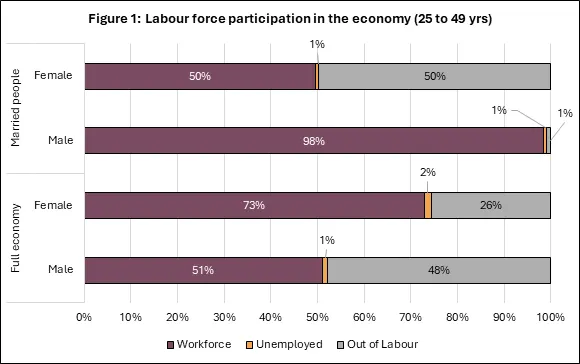
Source: Authors computation of PLFS, 2025
Of these, 14.2 million married women reported having worked earlier before dropping out. Amongst married women in prime working age who worked and then stopped, 85% cited care-related reasons [Figure 2], a clear caregiving cliff. These exits are concentrated among women aged 25-35, the years when careers, promotions, and networks are built, but for many they instead become years of economic withdrawal.
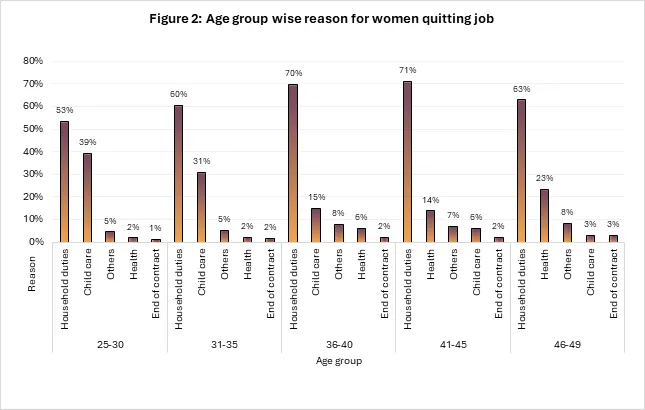
Source: Authors’ computation of PLFS, 2025
The penalty doesn’t end with labour force exit; it also depresses women’s earnings. Among regular salaried workers, unmarried women actually earn more than unmarried men. But this advantage disappears after marriage. Married women in salaried employment earn substantially less than married men, while single salaried women earn nearly 30% more than married salaried women (Figure 3).
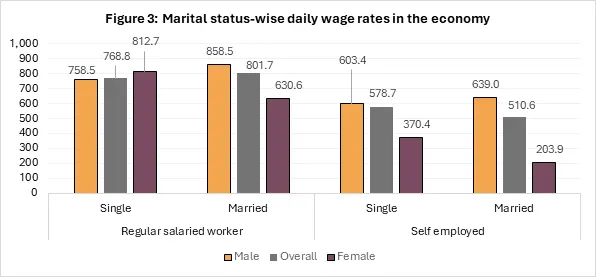 Source: Author's computation of the PLFS, 2025
Even more striking is the education breakdown (Figure 4). Among those who left due to childcare, the largest group (37.7%), or nearly 12.56 lakh women were graduates or held diplomas and above.
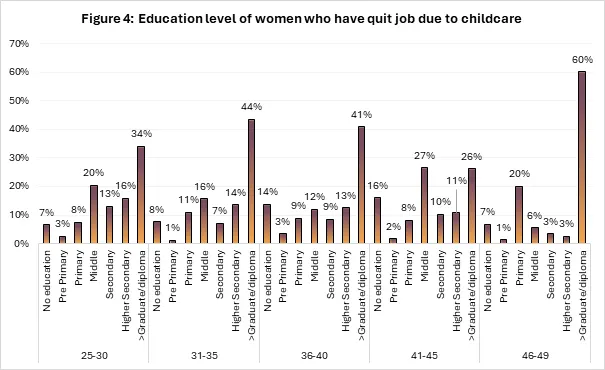
Source: Author's computation of the PLFS, 2025
The cost is not just borne by mothers — it’s a loss to the economy
The motherhood penalty is not merely a private loss; it is a macroeconomic one. At the average daily wage of salaried married women, the 33.4 lakh who leave the workforce due to childcare forgo about ₹52,600 crore annually, a conservative estimate as it assumes all women who leave are regular salaried and it excludes losses from seniority, pensions, and career progression.
The other major loss stems from unpaid care work. India’s 2024 TUS shows women spend 341 minutes a day on unpaid domestic and care work, which is eight times more than men’s, far above the global average gap. Nearly 86% women who aren't in the workforce either cite childcare or household duties, regardless of age group. This invisible labour is estimated to contribute nearly 7.5% of GDP. The ILO estimates that a more equal redistribution of care work could raise India’s female labour force participation to 40% by 2030 and add nearly $250 billion to GDP.
What needs to change
The evidence shows India is not just losing workers but its most educated women to an unpaid, invisible, and largely feminised care economy. Addressing this requires coordinated action from the state, employers, and society.
First, India must build the childcare infrastructure on priority. Beti Bachao Beti Padhao helped girls enter school; the next step is ensuring women remain in the workforce after motherhood. The Palna Crèche Scheme needs greater funding. Crèche laws under the Maternity Benefit Act and Factories Act require stricter enforcement. Models like Germany’s federal Kita system could offer inspiration, guaranteeing childcare for children above one year, with enrolment above 90%. India needs a similar system across villages, industrial clusters, and cities.
Second, caregiving must no longer remain a woman’s burden alone. India’s 26-week maternity leave was progressive in intent, but without paternity leave it also raised the perceived hiring cost of women. Norway’s Daddy Quota model helped reduce its workforce participation gap from 20 to 5 percentage points between the 1980s and 2018. India needs shared parental leave partly funded through social insurance, not just employers. Flexibility must become a statutory workplace right for both men and women. Parents of young children should be able to request remote or flexible work arrangements without facing penalties in promotions or career progression.
Third, governments should also incentivise women’s return to work. Malaysia’s Career Comeback programme offers tax incentives for women re-entering employment after career breaks, while Russia’s Mom Entrepreneur initiative supports maternal self-employment. India should adapt similar policies to make jobs and entrepreneurship more friendly for mothers and married women.
Fourth, cities must become care-friendly, with lactation rooms, stroller access, safe parks, and accessible transport as essential infrastructure for women’s workforce participation.
Fifth, employers must go beyond symbolic diversity policies by providing childcare to all parents, not as a women-only perk, and by creating strong re-entry pathways with reskilling, mentorship, and fair reintegration. Companies such as the Mahindra Group have shown this is possible, but isolated corporate good practice is not enough.
Lastly, unpaid care work must be counted properly. The TUS should become a regular exercise linked to gender budgeting, while PLFS should routinely publish maternal employment indicators.
Countries that have made progress share one common trait: they stopped treating care as a private, feminine issue and instead as shared economic infrastructure. India already has the evidence. It now needs the ecosystem.