May, 2026
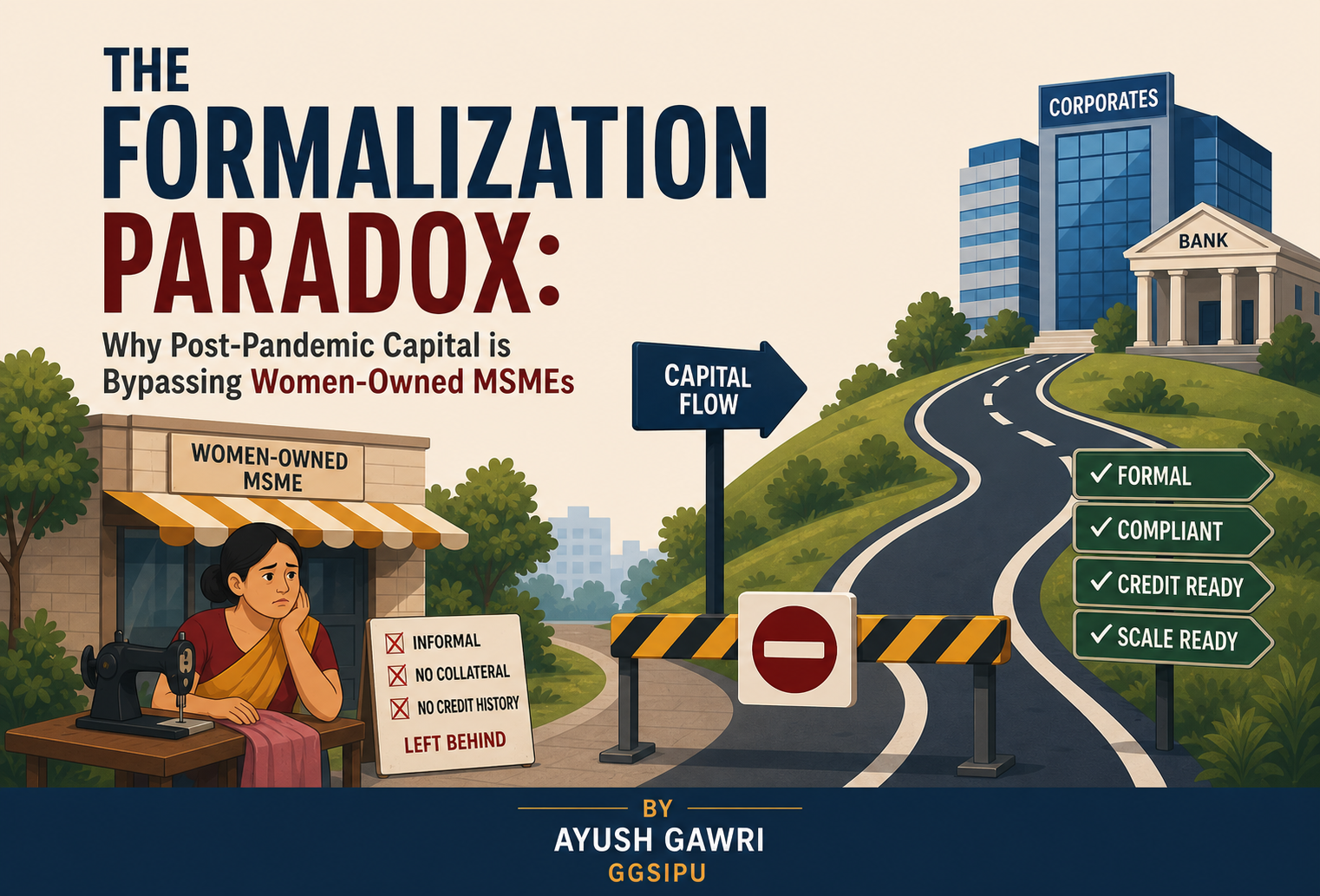
When macroeconomic shocks decimate markets, capital destruction is visible. What remains invisible, however, is the systemic exclusion embedded in the recovery mechanisms. Following the pandemic, the prevailing economic narrative insisted that injecting liquidity into the Micro, Small, and Medium Enterprise (MSME) sector would naturally catalyze recovery. Yet, a closer examination of ground-level financial ecosystems reveals a harsh reality: post-pandemic growth constraints for women-owned micro-enterprises are not merely a byproduct of lost revenue. They are the result of a severe "Compliance-Credit Paradox."
We have constructed a financial architecture that demands strict formalization as a prerequisite for institutional support. For women entrepreneurs operating at the micro-level, this demand is not just an administrative hurdle; it is an insurmountable barrier to entry that chokes their post-pandemic recovery.
The Literature and The Collateral Deficit
To understand this paradox, we must look at the structural baseline. Data from the International Finance Corporation (IFC) consistently points to a multi-billion-dollar financing gap for women-owned enterprises in developing economies. Academic literature often attributes this to socio-cultural biases, but the friction at the bank counter is fundamentally operational. Traditional commercial banking is anchored in collateral-backed lending.
In India, female property ownership remains disproportionately low. When a female entrepreneur—perhaps running a localized garment manufacturing unit or a boutique cloud kitchen—attempts to scale post-pandemic, she cannot leverage real estate. She is forced into the market for unsecured business loans. To mitigate the risk of unsecured lending, financial institutions demand airtight historical data: three years of audited Income Tax Returns (ITR), flawless GST reconciliation, and robust corporate governance structures.
Herein lies the trap. Maintaining this level of formal compliance requires capital, dedicated accounting bandwidth, and time. For a business decimated by lockdowns, these are resources that simply do not exist.

Figure 1: Estimated Formal Credit Gap across Indian MSMEs. The disproportionate 'Unmet' demand highlights the collateral and compliance friction faced by women entrepreneurs. Source(s): Own elaboration based on IFC baseline data.
The Behavioral Economics of the Shadow Economy
Working intimately with small business ledgers and taxation structures reveals a stark gender divide in how micro-enterprises approach formalization. Through the lens of behavioral economics, the decision to remain in the informal "shadow economy" is entirely rational for a female micro-entrepreneur.
Consider the unit economics of a woman running a localized retail operation. The immediate financial and mental cost of formalization—hiring a tax professional, navigating the complexities of the GST portal, and risking penalization for late filings—is concrete and immediate. Conversely, the benefit of formalization—the mere probability of securing a bank loan at some undefined point in the future—is abstract and delayed.
Faced with this asymmetric risk-reward ratio, she naturally chooses informal survival. She avoids the tax net and relies on high-interest informal lenders or depletes her personal savings to restock inventory. However, in a post-pandemic economy that heavily rewards digital footprints and formal compliance, staying informal ensures that her business remains stunted.
Case Scenario: The ESG Supply Chain Blockade
The constraints extend far beyond commercial banking. They are actively present in modern corporate supply chains.
Post-pandemic, large corporations have aggressively expanded their Environmental, Social, and Governance (ESG) mandates. Diversifying vendor bases to include women-owned enterprises is a prime corporate governance objective. Theoretically, this B2B integration should be a massive growth engine for female micro-entrepreneurs. The reality of the "Procure-to-Pay" cycle dictates otherwise.

Figure 2: The B2B ESG Procurement Trap. Standard corporate payment cycles inadvertently freeze the working capital of micro-enterprises, stalling growth. Source(s): Own elaboration.
Imagine a scenario where a female entrepreneur running a sustainable packaging unit successfully pitches to a mid-cap FMCG corporation. She wins the contract. However, the corporate entity operates on a standard 90-day payment cycle and requires digital e-invoicing and stringent ISO certifications for vendor onboarding.
To fulfill the order, she must purchase raw materials upfront and pay her localized labor force in cash. She must then surrender her goods and wait three months for the corporate invoice to clear. Because she is a micro-enterprise, she lacks the deep working capital required to float three months of operating expenses. The very corporate system attempting to empower her ends up paralyzing her cash flow. She is ultimately forced to forfeit the high-value B2B contract and retreat to highly volatile, low-margin B2C sales.
The Invisible Burden of Care Work
Any analysis of post-pandemic constraints is incomplete without addressing the allocation of time. The pandemic permanently altered urban domestic dynamics, drastically increasing the burden of unpaid care work.
While supply chains have normalized, the "double burden" has not subsided. For a male entrepreneur, the hours between 9 AM and 6 PM are purely dedicated to business development and financial management. For a female entrepreneur operating from a hybrid or home-based setup, these hours are heavily fragmented by caregiving responsibilities. This fragmentation acts as a hidden tax on her productivity. It leaves her with zero excess bandwidth to focus on the bureaucratic heavy lifting required to formalize her business, apply for government subsidies, or network for institutional credit.
Strategic Policy Recommendations If we intend to transition women-owned MSMEs from mere post-pandemic survival to aggressive economic growth, our policy interventions must shift from generic capital distribution to structural, ground-level reforms.
1. Government and Regulatory Interventions (Ministry of Finance & RBI):
• The "Safe Harbor" Compliance Runway: The government must introduce a deferred compliance framework for newly registered women-owned micro enterprises. Instead of immediate, rigid GST mandates, these businesses should be granted a 24-to-36-month "Safe Harbor" period. During this window, they can operate formally, build a digital banking footprint, and file simplified, flat-rate annual reports without the threat of immediate tax audits or penalties.
• Algorithmic, Cash-Flow-Based Underwriting: The Reserve Bank of India (RBI) must incentivize commercial banks to abandon collateral-heavy lending for micro enterprises. Banks should deploy alternative credit scoring models that evaluate the digital pulse of the business—analyzing UPI transaction velocities, digital wallet cash flows, and utility payment consistency—to underwrite working capital loans.

Figure 3: Proposed 'Safe Harbor' Compliance Runway. A staggered formalization timeline to bridge the gap between informal survival and institutional credit readiness. Source(s): Own elaboration.
2. Private Sector and Corporate Governance Reforms:
• Zero-Day Invoice Clearing for Micro-Vendors: It is insufficient for corporations to simply set ESG procurement targets. Private sector leaders must overhaul their accounting systems to support "Supply Chain Financing." Mandating a zero-day or maximum 7-day invoice clearing cycle specifically for women-owned micro-vendors will instantly eliminate their primary existential threat: working capital paralysis.
• NGOs as Compliance Incubators: Non-Governmental Organizations must pivot from providing basic vocational training to acting as "Compliance Incubators." NGOs should provide pro-bono accounting, tax filing, and digital onboarding services, absorbing the initial administrative friction until the business reaches a sustainable scale.
Conclusion The survival of women-owned MSMEs through the pandemic was a testament to extreme resilience and informal community networks. However, resilience is not a scalable business model. We have constructed a financial ecosystem that demands perfect compliance before it offers a lifeline. By dismantling these initial compliance barriers, reforming corporate payment cycles, and leveraging alternative digital data for credit, we can transform women-owned micro-enterprises from invisible economic participants into the primary engines of our macroeconomic future.