May, 2026
The Gateway Effect
Some economists attribute India’s stagnant urban FLFPR to an income effect: rising incomes allow women to exit necessity-driven work before education pulls them back. But India’s women now outnumber men in higher education, at 28.5 percent gross enrolment ratio against 27.9 percent for men (All India Survey on Higher Education, 2022), and urban FLFPR has not moved (Ravi & Kapoor, 2024). The Mumbai RCT identified something more precise: the daily household veto. Husband opposition alone prevented 15 to 27 percent of women from accepting office roles, varying by income group (Jalota & Ho, 2024). WFH bypassed this, preserving domestic appearances while quietly bringing wages in. What could be called a gateway effect followed: within six months, women who had refused office jobs were saying yes. Decades of gender-norm mandates never got there. WFH opens the door. It does not change what is waiting on the other side.
The Double Shift
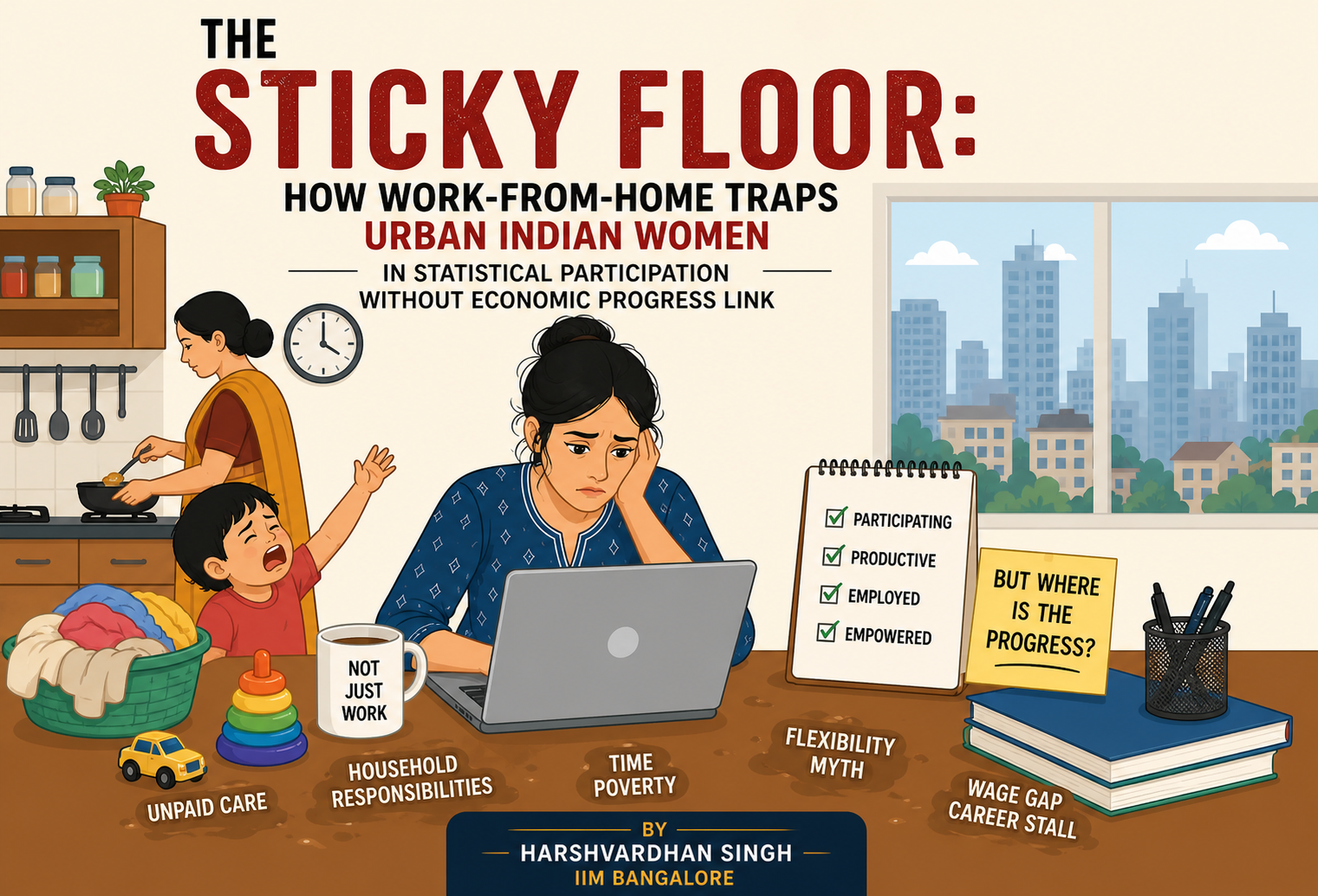
The trouble begins once the work starts. India’s Time Use Survey 2024 (Ministry of Statistics and Programme Implementation, 2025) records women spending 289 minutes daily on unpaid domestic work and 137 on caregiving, against 88 and 75 minutes for men. That is 2.6 times the unpaid burden before paid work begins, producing a combined daily workload of over 12.7 hours. This has not changed in five years: 10 minutes of reduction in female domestic work, zero shift in male participation.
When the office and kitchen share a room, that boundary collapses entirely. Domestic demands do not wait until paid hours are over. Nelson and Agarwal (2023) documented this as a double bind: WFH women are expected to perform as workers and primary caregivers in the same space simultaneously. The Mumbai RCT measured the consequence: lower accuracy and higher error rates, traced to childcare interruptions during paid work hours (Jalota & Ho, 2024). The double shift is not a metaphor. It shows up in the productivity data.
The Quality Deficit
India’s aggregate FLFPR reaching 41.7 percent in 2023–24 has been widely celebrated. Deshpande (2025) makes a persuasive case for why it should not be. The surge is overwhelmingly driven by rural women entering distress-driven agricultural work: a coping response to stagnating household incomes, not structural inclusion. Urban FLFPR registered 25.2 percent in Q3 2024–25, barely distinguishable from 2020 (Ravi & Kapoor, 2024).
Rural migrants face a further layer: network and residency barriers block formal urban employment for years.
Within the digital workforce, the picture is similarly uneven. Fernandez et al. (2025) found that device access alone is insufficient: urban women need personal device ownership and genuine digital literacy for measurable labour market gains. Most WFH gig workers have not reached that threshold. Gender x Digital Hub (2025) show the outcome: women concentrated in lowest-value micro-tasking, earning roughly 82 percent of male wages, with no visible path upward.
The Engineered Market Failure
Ask any HR manager at a Bengaluru startup, off the record, whether maternity enters hiring decisions for women under 35. The honest answer is yes. India’s Maternity Benefit (Amendment) Act 2017 explains why. The Act places the full cost of 26 weeks’ leave on the individual employer: no state subsidy, no pooling, just a liability on whoever hired her. A finance team running a headcount model reads this correctly. Women of reproductive age carry an uncertain, employer-borne cost. The PLFS series documents the result: informal and contract employment among urban women grew as formal salaried employment stagnated, consistent with firms routing female labour through gig arrangements to avoid this exposure (Ministry of Statistics and Programme Implementation, 2024). Culture creates the preference. The law creates the discount.
Policy Recommendations
Each of these failures has a specific corrective.
For the Government, transition the Maternity Benefit Act to a National Parental Insurance Fund managed by EPFO, with contributions shared by employers, employees, and the state. Over 70 percent of OECD economies have done this (Mitra & Ramesh, 2025). When maternity costs are distributed across the entire workforce, the pricing signal driving firms toward gig-routing disappears. This must work alongside the Paternity and Paternal Benefits Bill 2025, enacted with a non-transferable 30-day paternity quota. Voluntary leave is returned to women in almost every case; only forfeiture creates real household redistribution (OECD, 2021). Neither works in isolation: the insurance fund removes the employer’s incentive to discriminate; the quota removes the household’s incentive to hand care back to women.
For the Private Sector, Gender x Digital Hub (2025) identify digital presenteeism, constant availability and fast response-time metrics, as the primary mechanism suppressing remote
female wages. IT firms and GCCs need output-only appraisals. SEBI’s BRSR Core (2023) mandates board-level gender disclosures but says nothing about remote work equity. That gap needs closing.
For NGOs, state infrastructure has failed: Palna’s operational crèches fell from 3,158 to 2,163 in 2023–24, with Maharashtra recording zero. NGOs should build Urban Micro-Care Cooperatives: groups of 15 to 20 WFH women pooling resources to fund trained local caregivers, adapted from Kerala’s Kudumbashree model (Kerala State Poverty Eradication Mission, 2023). At roughly Rs.8,000 to 12,000 per cooperative monthly, this is viable under the Palna scheme supplemented by NRLM convergence funds.
For Educational Institutions, AICTE polytechnics working with NASSCOM must go past digital literacy. Literacy teaches women how to use the tools. Power teaches them how to refuse the terms.
When these levers work together, the floor becomes a foundation. The evidence is primarily formal-sector and Mumbai-weighted; smaller cities will need adapted approaches.
Conclusion
Every PLFS release comes with a press note celebrating rising female participation. The real story is elsewhere. She works across interruptions she is expected to absorb, manages a household nobody else runs, and gets passed over for promotions she has earned. Work- from-home did not free her from any of this. It put all of it in the same room. India should expand WFH. But the harder question is whether the home Indian women work from becomes shared ground, or just a more convenient location for the same extraction. Until care is treated as economic infrastructure, India’s FLFPR will keep reading as Deshpande (2025) puts it: “too good to be true.” The measurement is Deshpande’s warning. The mechanism is the sticky floor. This article is the explanation.
References
All India Survey on Higher Education. (2022). AISHE report 2021–22 (tech. rep.). Ministry of Education, Government of India.
Booth, A., Francesconi, M., & Frank, J. (2003). A sticky floors model of promotion, pay and gender. European Economic Review, 47(2), 295–322.
Deshpande, A. (2025). Too good to be true? Steadily rising female labour force participation rates in India.
Fernandez, C., Prakash, S., & Puri, H. (2025). Digital technology as an instrument to bridge gender gaps in access to labour markets (tech. rep.). UNDP-ICRIER Policy Brief 31.
Gender x Digital Hub. (2025). Decoded: Women and the future of digital work in India
(tech. rep.). LEAD at Krea University & The/Nudge Institute.
Jalota, S., & Ho, L. (2024). What works for her? How work-from-home jobs affect female labor force participation in urban India. https://ssrn.com/abstract=4652678
Kerala State Poverty Eradication Mission. (2023). Kudumbashree: Community network overview (tech. rep.). Government of Kerala.
Ministry of Statistics and Programme Implementation. (2024). PLFS annual report 2023–24
(tech. rep.). Government of India.
Ministry of Statistics and Programme Implementation. (2025). Time use survey 2024: Key results (tech. rep.). Government of India.
Mitra, S., & Ramesh, A. (2025). The care economy: A case for expanding the role of the private sector (tech. rep.). ICRIER Policy Brief 35.
Nelson, M. M., & Agarwal, B. (2023). The rigmarole of negotiating double binds. South Asian Journal of Business and Management Cases, 12(3), 372–389.
OECD. (2021). Dare to share: Germany’s experience promoting equal partnership in families. https://doi.org/10.1787/e5e80c75-en
Planning and Economic Policy Division, EAC-PM. (2024). State of the economy: Female labour force participation (tech. rep.). Economic Advisory Council to the Prime Minister, Government of India.
Ravi, S., & Kapoor, M. (2024). Female LFPR: An observational analysis of the Periodic Labour Force Survey 2017–18 to 2022–23 (tech. rep.). EAC-PM Working Paper, Government of India.