Mar, 2026
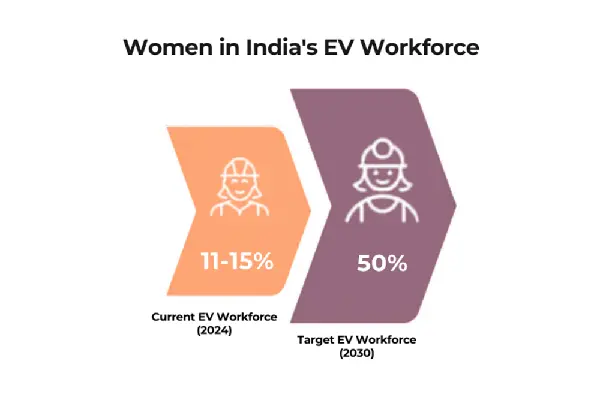
The transition to electric mobility (EM) in India is more than a technological shift; it is a structural shift for the country’s industrial pathway. As the country advances toward its target of achieving 30% EV sales by 2030, governments, industry and the skilling ecosystem must intentionally work towards integrating women in the entire value chain—from research and development to the shop floors, charging networks and as EV drivers. With targeted measures, it may be possible to increase women's representation in the EV workforce in India. Currently, women account for only 11–15% of the overall EV workforce, and industry leaders anticipate this could reach 50% by 2030 if strategic interventions are made (Ola Mobility Institute, 2024).
Electric Mobility Offers a Unique Opportunity for Women in STEM
Globally, women constitute around 45% of jobs in scientific research in energy and energy-adjacent sectors. In the European Union, while 48% of doctoral graduates are women, a mere 22% are in information and communications technologies (ICT), a field critical for driving productivity growth and already facing acute skill shortages. When it comes to the EV landscape, women are underrepresented across the spectrum – from manufacturing to services jobs.
Manufacturing and Assembly
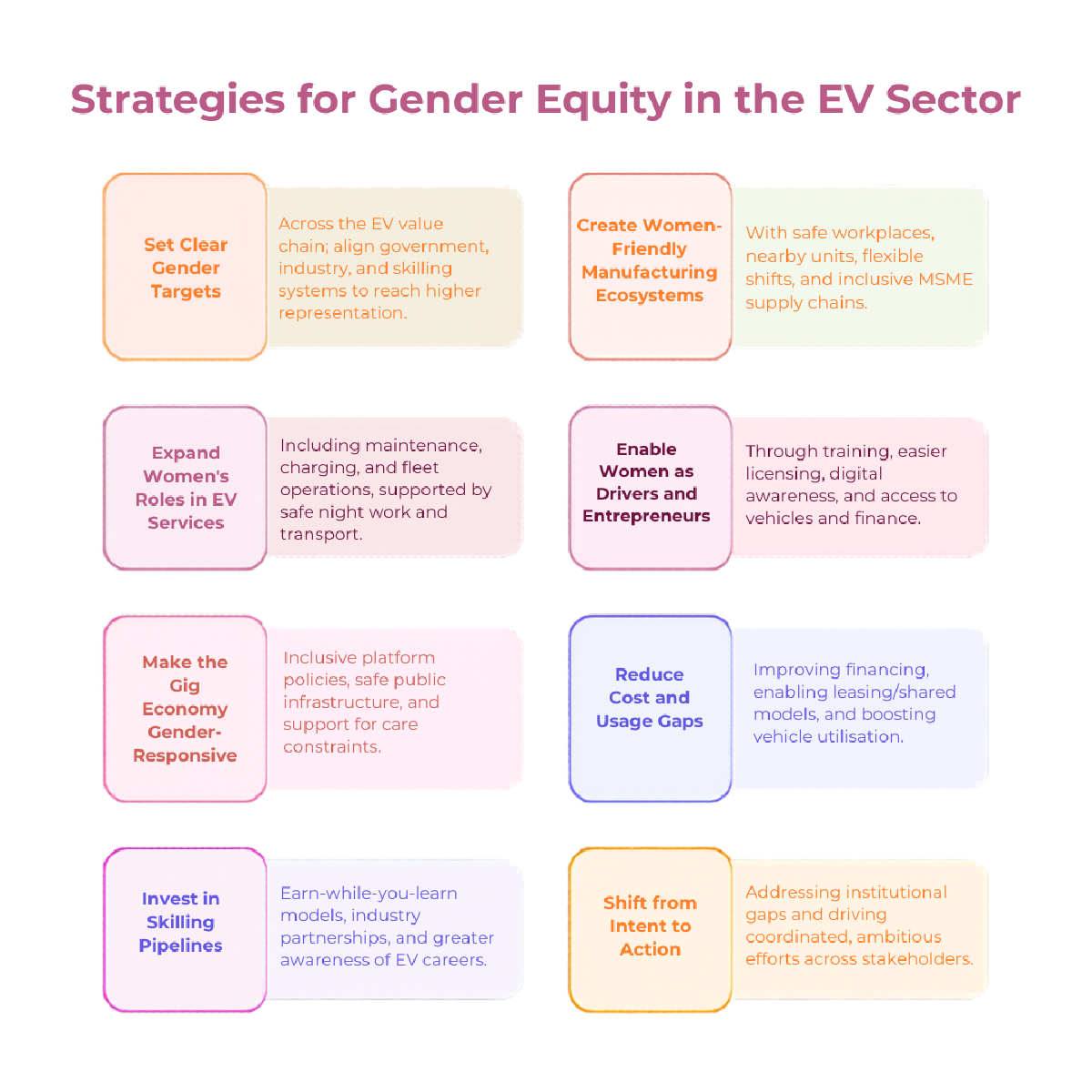
EV manufacturing is less about heavy mechanical casting and more about high-precision electronics and chemical handling. The manufacturing industry is leveraging this in various ways. Numerous companies in India have introduced women-only or women-majority shop floors, ranging from JSW MG Motors, Ola Electric, Ather Energy, Kinetic Green, Tata Motors. This may be a strategy to demonstrate and build confidence amongst women and within their households about a safe and secure work place, in a sector that is heavily masculinised in its culture. JSW MG Motors also facilitated site visits by household members to the factory to instil trust.
Women are more likely to take and retain manufacturing jobs when the units are located within 1-2 km of their homes, as seen at Biliti Electric. It provides the flexibility to return home quickly during work hours if needed. Gravton Motors has adapted work shifts to accommodate women’s needs, resulting in higher retention rates.
The key challenges is with automotive component or ancillary suppliers, who maybe MSMEs and the extent to which they are able to ensure gender-inclusive shop floors. Since many factories are located in peri-urban areas, physical barriers such as a lack of safe transport to remote factory sites and inadequate sanitation facilities remain primary deterrents.
Services and Operations
The downstream is the least feminised, especially women as drivers of electric fleets or in EV operations and maintenance and supervisors. This is a lost opportunity for cities, especially as women’s urban labour force participation is abysmally low.
Electric buses include a wide range of roles such as charging technicians, ITMS and MIS executives, and supervisors. These offer an opportunity to enter the workforce with promotion prospects in 2-3 years. E-buses are maintained in the night, necessitating safe transport, emergency protocols and a secure work environment. Removing regulations to women’s work in the night is a first step in this direction as implemented by multiple states such as Tamil Nadu, Maharashtra, Delhi to name a few.
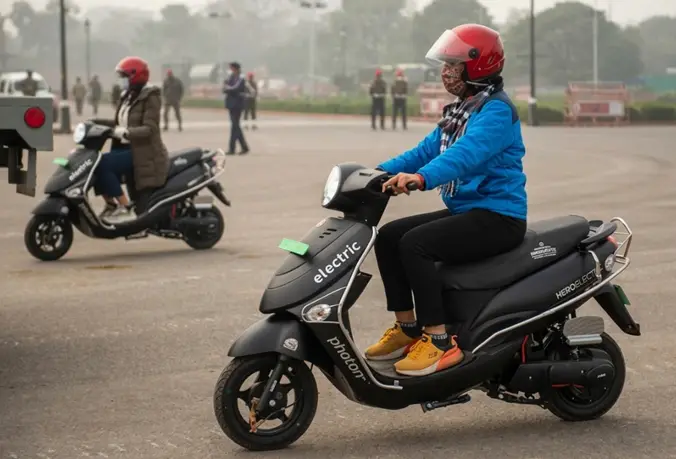
Women are underrepresented as drivers and delivery workers in India. Women constitute around 7% of drivers in the country, with this share increasing at 9% CAGR. Drivers of e-bike and e-bike taxi, e-auto, e-rickshaw offer scope. However, there are numerous barriers at this stage. For self-employed women, it is driving training, licensing process and access to a vehicle, and the lack of awareness about electric scooters.
The Urban Catalysts’ research with ICE and electric scooters in Delhi and Chennai revealed that women often relied on family members to learn driving, while men predominantly rely on friends or self-learning. Formal driving classes are rare for both genders, with only 8% of women and 2% of men using them. Respondents reported paying 2.5 to 2.7 times the prescribed fees to obtain a license, largely due to reliance on agents. Awareness of the shift to an online application process for driving licenses, implemented in 2023, is limited.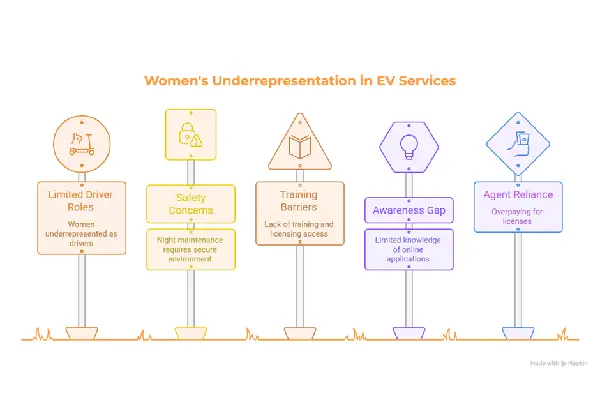
Digital and Technology Roles
Female commercial workers (predominantly registered on platforms) worked 95 to 167 minutes less than male workers, likely due to care responsibilities. While male workers earn 1.1 times more than female workers, this is primarily due to working longer hours. However, women earned a higher hourly income (INR 115) compared to men (INR 104), as they generally undertook shorter-distance orders, enabling them to complete more deliveries in less time. The total cost of ownership (TCO) for female electric scooter users is found to be 1.2 to 1.7 times higher than for male users due to differences in vehicle utilisation.
The gig economy, which includes urban last-mile logistics, home service workers, is projected to grow from 7.7 million (2020-21) to 23.5 million by 2029–30. Gender-responsive and accountable platform policies, safe and hygienic toilets including those in public spaces, will be crucial to ensure that women can benefit from the platform delivery and services economy.
Lastly, increasing women’s awareness of the potential jobs in the electric mobility sector, creating a pool of qualified and skilled female candidates through earning while learning programs, in partnership with skill development missions, sector skill councils and industry can ensure that women can benefit from this mobility revolution. The gap, then, is of intent and ambition in the ecosystem, rather than of capability.