Empowering Men’s Household-Work Participation
Author(s):
Ms. Shravani Prakash
Apr, 2024
Enabling men to embrace a more equitable share of unpaid domestic work is not just about fostering fairness within households; it is a pivotal step toward unlocking women's full potential in the workforce. Currently, only 26% of men engage in unpaid domestic work compared to 80% of women. Men, on average, spend one-tenth the time doing domestic work and one-third the time on care work as women but spend triple the number of minutes as women on paid work (Figure 1)
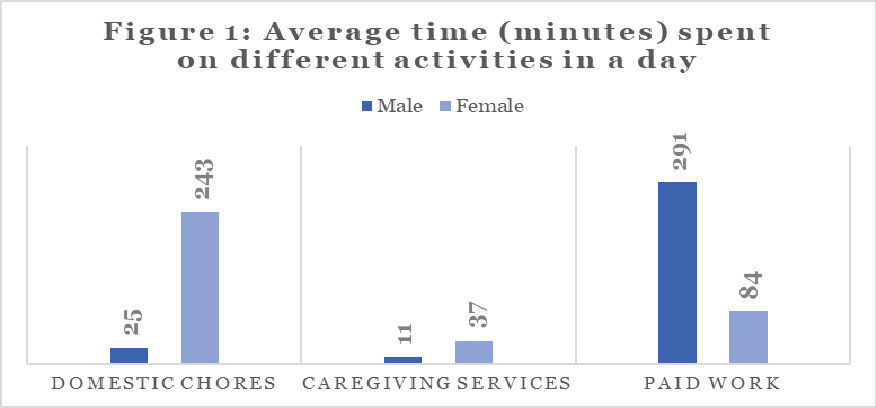
Source: Calculated using Time Use Survey in India, MOSPI
This disproportionate burden of housework often forces women to sideline their careers or abandon them altogether. For instance, comparing India with some OECD countries shows that India’s Female Labor Force Participation Rate (FLFPR) is the lowest among 11 countries, while the gender gap in unpaid care work remains alarmingly high (Figure 2).
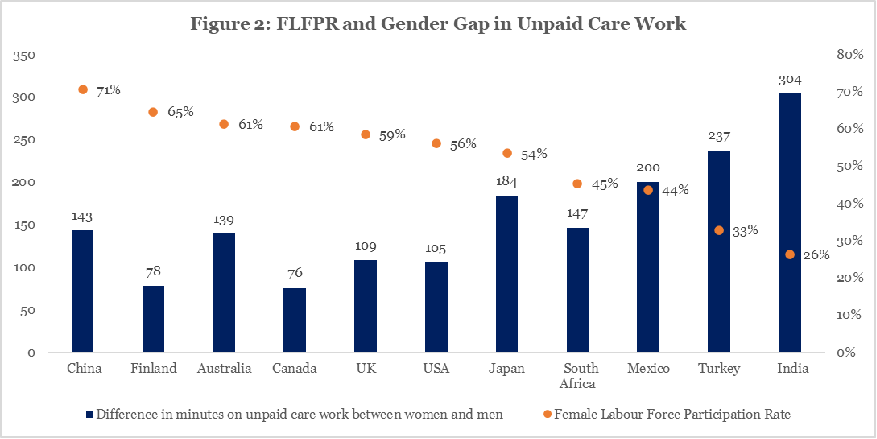
Source: Calculated using data from OECD Gender, Institutions and Development Database
Research indicates that a reduction in women's unpaid care work in an economy can elevate FLFPR by 10%. While establishing a robust care economy to alleviate women's unpaid workload is crucial, redistributing domestic responsibilities to involve men is equally essential. Increased male involvement not only affords women more opportunities for paid work but also fosters family a culture where future generations, both sons and daughters, perceive gender roles more equitably.
Recent trends show a gradual increase in men's participation in household chores, with studies even suggesting a positive correlation between men's engagement in housework and their happiness. However, at the current pace, achieving gender equality in unpaid care work could take up to 92 years.
To expedite progress, proactive measures are imperative to normalize caregiving and domestic tasks as shared responsibilities. This necessitates challenging existing narratives that confine such duties to women and redefining masculinity to include caregiving roles. Collaborative efforts from the government, private sector, and media are vital to driving this cultural shift.
Outlined below are actionable steps toward promoting shared caregiving and household responsibilities -
- Mandate Equal Parental Leave: Legislation should ensure equal and well-structured paternity and maternity leave, which has proven to enhance female workforce participation by at least 6.8%.
- Build “Caring” Workplaces - Organisations should be encouraged to build a culture where caregiving is valued and supported for all workers. Flexible and remote working options, childcare benefits and parenting support should be provided to both male and female employees. The top leadership must actively avail of these benefits to become role models and make all employees feel comfortable about doing so themselves.
- Establish a National Care Policy: The government should implement a comprehensive policy framework aimed at achieving equality in unpaid care work participation, alongside ensuring access to quality caregiving resources. The policy must also set a national target date for achieving equality in women's and men’s participation in unpaid care work.
- Promote Male Engagement in Maternal and Child Health: Government programs can encourage men's involvement in prenatal and maternal care, as this has shown improvements in women and children’s health outcomes. This could be enabled through tailored support programs such as training health workers to support men in caring for their partner’s health; or providing access to digital fatherhood preparation courses and information campaigns about men’s roles in the lives of children. In Brazil, for example, a “Pai Não É Visita” (The Father is not a Visitor) campaign encouraged hospitals to allow fathers into the delivery rooms and birthing process.
- ‘De-Feminise’ Government Programs Around Domestic Work And Caregiving –The branding of government programs like the Ujjwala scheme or Anganwadi program could be reframed to target men as well. In addition, programs could be introduced to enable men with caregiving skills as well, like Zimbabwe’s “Africare’s Male Empowerment Project” that trained and supported men to become effective secondary caregivers to people living with AIDS.
- Design Inclusive Public Infrastructure: Public infrastructure and facilities need to be made inclusive to even accommodate men's caregiving roles, such as installing diaper change facilities in men's restrooms or building family toilets in public spaces.
- Integrate Gender-Sensitive Education: The education system needs to revise the curricula to instil gender equality principles and equip boys with life skills traditionally associated with caregiving. While India’s New Education Policy (NEP) includes an element of ‘Equitable and Inclusive Education’, the focus is on enrolment but not on imparting a "gender-sensitive curriculum". The curriculum should be designed to teach girls and boys that they have equal rights and duties; and encourage boys to question and go against patriarchal practices.
- Challenge Gender Stereotypes in Media: The media should be directed to portray fathers as competent caregivers and showcase diverse family dynamics. While the media has begun to portray working mothers as “super-women” who successfully juggle multiple duties, fathers are often portrayed as being incompetent or “clumsy” at their attempts at multitasking, cooking or babysitting.
- Mobilize Influencers: Political and other opinion leaders need to be rallied to advocate for gender equality at home and encourage society to challenge traditional norms. For example, The “Because I am a man” campaign in the Arab countries is calling on political and opinion leaders, policy makers, private sector and civil society organizations to bring changes in the legislative and policy realm.
- Harness Technological Solutions: Innovative gadgets and digital apps have proven to enable a greater participation of men in household activities like paying utility bills or ordering groceries online. Further, emerging AI-based technologies may facilitate men to undertake more and better household chores and caregiving duties. Therefore, the growth of such startups and technology firms must be encouraged. The Government can itself promote innovative technology-based solutions, like the Spanish government’s free app to record and redistribute the invisible "mental load" of housework disproportionately borne by women.
- Diversify Care Professions: To break down stereotypes and de-stigmatise male caregivers, the recruitment and training of men should be encouraged in caregiving professions such as primary school teachers, early childhood caregivers, and nurses.
By implementing these strategies, we can expedite progress towards gender equality, fostering inclusive societies where caregiving is valued and shared by all.