Dec, 2024

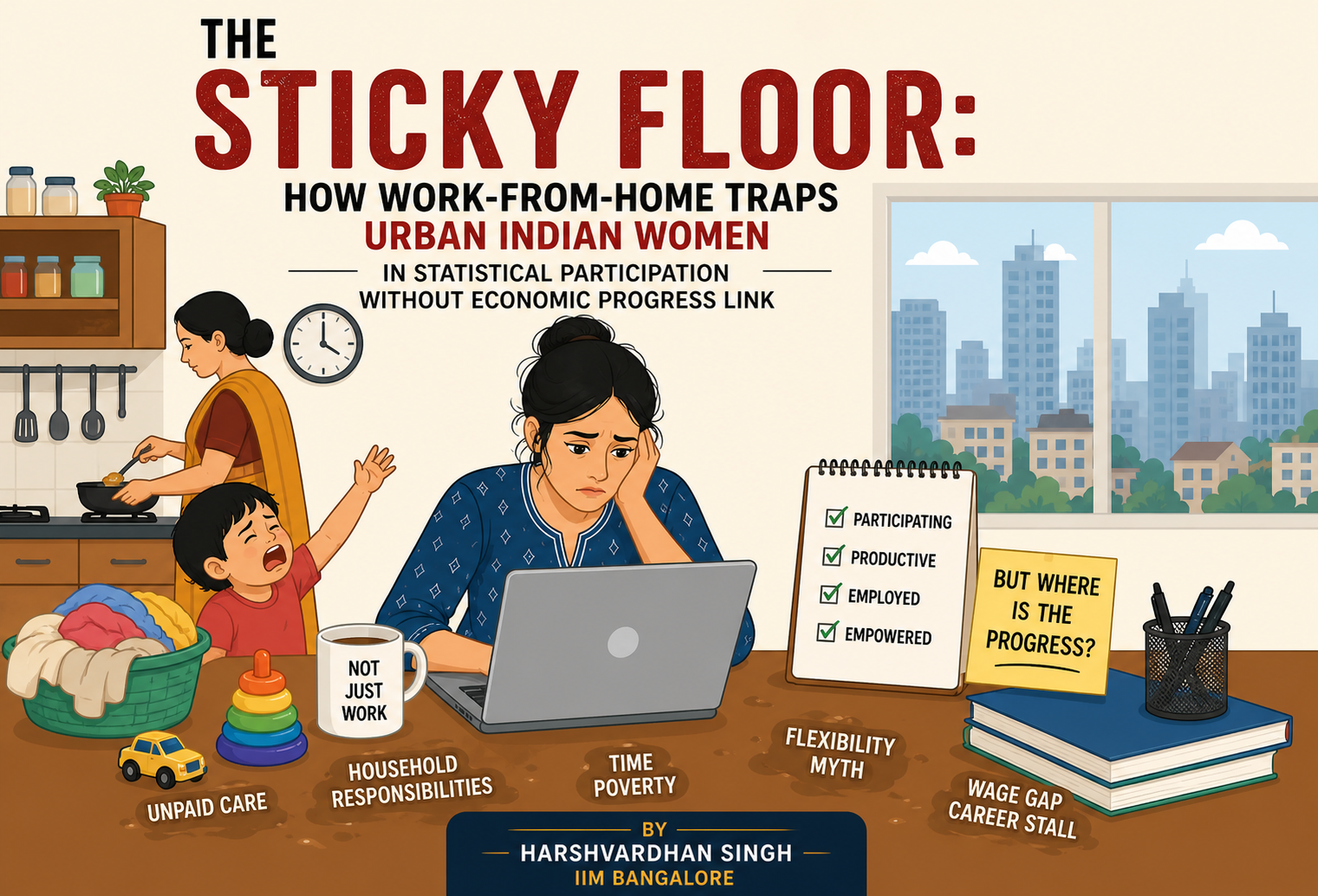
Participation in the labour force is seen as a measure of empowerment, particularly for women. However, a woman’s labour, like the rest of her life, is not completely her’s to control. Large parts of her time go into unpaid ‘care work’, while her ‘productive labour’ or work that leads to income becomes camouflaged within the larger work environment of the family that she is a part of. Therefore, the real “empowerment” of a woman from joining the workforce will happen only once it leads to the development of her agency, opportunities to engage with the world, the ability to build social networks, earn an income, and gain financial independence.
TheAnnual report(1) of the periodic labor force survey (PLFS) in September 2024, by the Ministry of Statistics and Program Implementation, has thrown up some interesting results for India’s female labour force participation. The survey shows that rural women’s labour force participation at 35.5% is 13% higher than urban women’s at 22.3%. But the numbers mostly indicate self-employment, with more women helping in household enterprises or working as casual labour while only 7.8% being on a regular wage/ salary. Self-employment can mean poor wages, limited opportunities for skill upgradation, and being employed in the informal sectors with unregulated working conditions!
The Tamil Nadu Scenario
Tamil Nadu is one of the most urbanized states of India, contributing to 9.3% of the urban population of the country with 48.5% of the state’s population residing in urban areas. Tamil Nadu’s annual PLFS data for the percentage of women in the labour force at 24.4% in urban areas is not that different from the national figures at 22.3%! In both cases the corresponding figures for men are 59.2% and 59% respectively, showing a gender gap that is over 30%.
However, in Tamil Nadu’s urban areas, 55.4% of those women who are participating in the labor force are engaged in regular/wage and salary employment. Though this is similar to the national trend where 49.4% of the urban women in the labour force are in the regular wage/salary, the similarity can be safely attributed to the national figures not being exclusive but averaging from states like Tamil Nadu.
Where are the women in Tamil Nadu working?
Five industries account for more than half of Tamil Nadu’s total industrial output- garments (apparel), textiles, automobiles, food products, and leather and related products. All these industries are also high employers of women, with services and manufacturing being the most important sectors where 64% of women in urban Tamil Nadu are employed(2), which is higher than 43% for India, Gujarat (44%) and Maharashtra (35%).
Feminization of the Industrial workforce in Tamil Nadu
Tamil Nadu is not only the state that ranks at the top in total number of industries but it is also estimated that 42% of women working in India’s factories reside in Tamil Nadu, working in the 38,837 factories(3) that mostly employ women. This trend seems similar to China, where a large number of women work in factories with many being migrants from outside, due to the state’s push to engage women in the industrial force by providing an ecosystem like housing around the workplace. One of the best examples of this is Foxconn - the iPhone manufacturing company from Taiwan. Foxconn has set up a manufacturing facility in Sriperumbudur on the outskirts of Chennai, which has a residential facility of 13 floors spread over 20 acres that can house 18,720 women(4). Out of the 41,000 workers in the factory, 35,000 are women!
In addition to housing, there have been certain policy changes at the state level to encourage more women’s employment in industries. In 2017, the amendment to the Tamil Nadu Factories rule (1950) removed restrictions on women’s employment by allowing them to work night shifts. Tamil Nadu’s budget has launched a payroll subsidy of 10% of the salary of women (and other marginalised people) to incentivise employers to hire women(5).
Underlying biases still persist despite ecosystem changes
While there seems to be the creation of an ecosystem that is paving the way for greater engagement of women in the industrial workforce, we need to do a deep dive to understand the outcomes better.
An investigation conducted by Reutersin early 2024 on Foxconn found that the company systematically excluded married women in their recruitment, citing pregnancy, family duties leading to absenteeism, and “jewellery worn"(6) as interfering with production. While this brings up the question of the ethics behind the recruitment process and reinforcing gender stereotypes, it also demonstrates the reduced employer commitment to social security measures such as childcare services.
The preferred recruitment of women in the industrial workforce, given the state’s push towards it, has to be put into perspective. For the employer, profit is the driving factor - women are preferred because they are easier to manage, do not unionize, and are likely to be less aware of labour rights. But families also prefer to send their women to work in an all-female work environment, and women’s income is easier to control at the household level.
Moving women beyond labour force participation towards building their agency
As a first generation out of rural work, are women prepared for the industrial work environment? This needs to be looked at in a nuanced manner with a plan to build preparedness to deal with the challenges.
Following are some of the strategies that can be considered by the government:
1. Pre-employment training on labour rights and social security entitlements for all women recruited in industries is important. It can be done at the high school, college, or skill training institutes as also at the community training programs.
2. Encouraging employee development forums in the industries where women are given time to discuss their work-life challenges. Civil society organizations can be facilitators providing counselling services- both psycho-social and legal.
3. Encouraging employers to build a mentorship program, assigning each woman employee to a female mentor who can help them build a personal and professional growth trajectory.
4. Wherever women are housed in hostels around the factories, the living space can be used after working hours for encouraging skill upgradation programs for the residents.
To conclude, it can be said that while employment of women in the industrial workforce might result in easing their entry into the formal sector, women’s labour should result in building her agency and not just industrial productivity for the company and GSDP for the state. Beyond all the encouraging statistics, what is more important is women need to be empowered in real terms and it is only by close monitoring that the state can ensure that!
References
(1). Periodic labour force participation survey 2023-2024
(2). State Planning Commission
(3). RBI’s Handbook of Statistics on Indian States 2021-2022,
(4). Indian Express, Aug 18th , 2024
(5). The Hindu Feb 2024. Part of the budget announcement by Industries minister
(6). Reuters special report , June 25th 2025