Nov, 2026
India, and Karnataka in particular, has invested in childcare centres to help mothers return to work. Yet many young mothers are not making full use of them, and remain out of work or leave education early. This study set out to understand why.
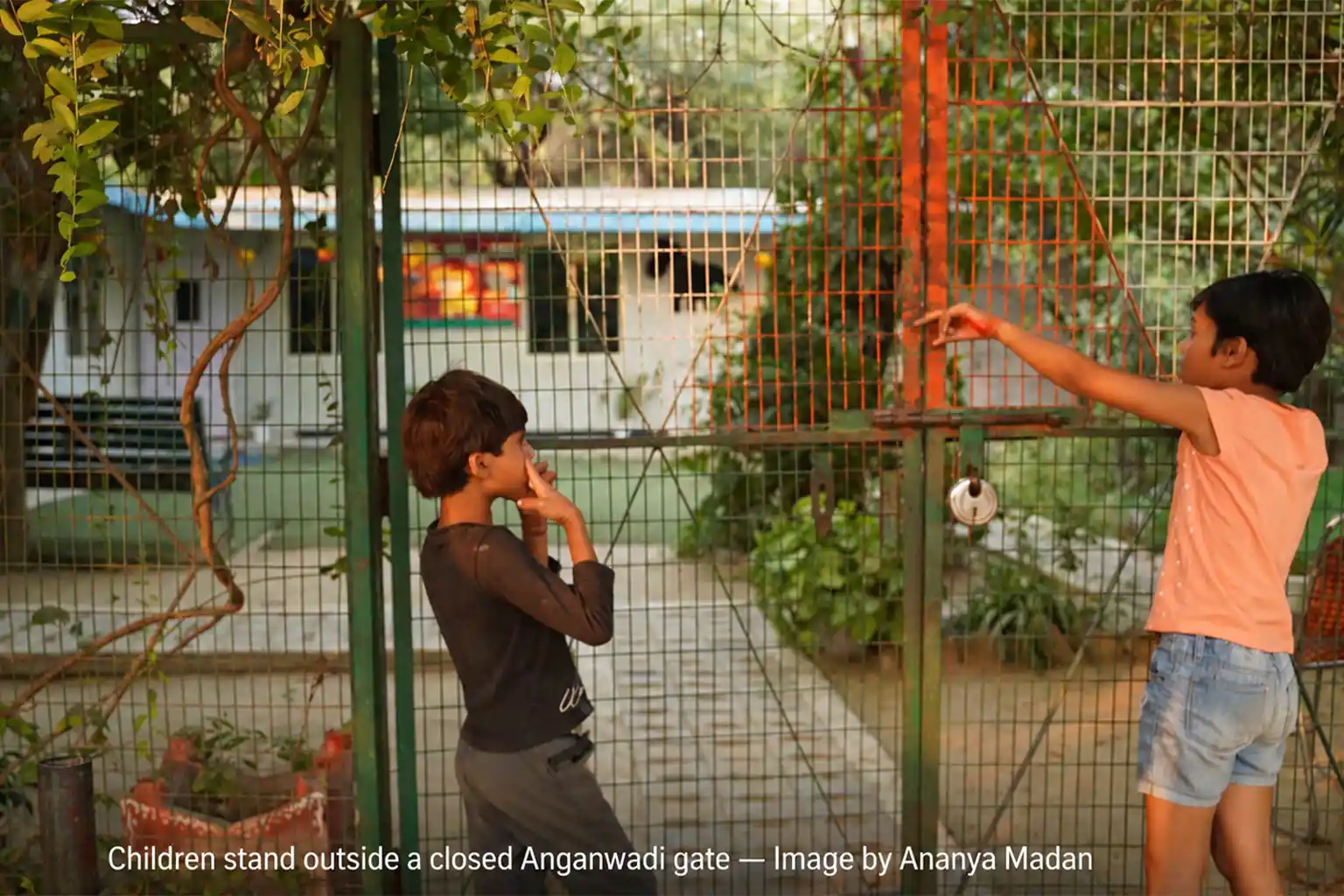
“The timings of these centres do not match my work timings. They start around 10 am and end at 3 pm, but I work as an agricultural labourer with an 8 am reporting time.”
— Young mother, Kodagu
By the time the centre opens, she has already been at work for two hours. Her story is one that is familiar across rural Kodagu.
Kodagu, a coffee-growing district in Karnataka, offers a clear view of this pattern. Many women from lower working-class families, who worked on coffee estates and farms, stopped going to work after they gave birth, and most never returned. Understanding why matters, because stepping away from work also meant giving up the chance to become educated and financially independent.
Karnataka has not neglected women’s well-being; it has done relatively well. It has built crèches into its rural employment scheme and introduced free bus travel for women through Shakti, along with a monthly payment of ₹2,000 to women heads of household through Gruha Lakshmi.1 Yet in Kodagu, many young mothers still did not return to work.
This question led to a policy paper at the London School of Economics and Political Science (LSE) on why young rural mothers in Karnataka are not returning to education and employment. Between April and May 2026, the study conducted 20 semi-structured online interviews with young mothers aged 18–26 and Anganwadi workers in Kodagu. Twenty interviews cannot speak for all of rural India, but the findings challenge a common assumption: for most women, the story does not begin with motherhood at all.
The study draws on Amartya Sen’s idea that development means expanding people’s real freedoms: the choices they are actually able to make.2 Three of these freedoms were missing for the mothers interviewed. The first is economic facilities, the education and skills that open doors to work. The second is agency, the ability to pursue goals according to one’s own values. The third is protective security, a safety net that stops people from falling into hardship. The findings show that childcare schemes address none of these directly.
India has invested in childcare infrastructure through Anganwadi centres, which provide health, nutrition and pre-school services for children aged 0–6, but typically open only from mid-morning. Karnataka has gone further. Its Koosina Mane crèches, set up for the children of informal women workers, care for children aged six months to three years for at least six and a half hours a day, with timings that can be adjusted to mothers’ work schedules. Gram panchayats, in partnership with the Women and Child Development department, run them and staff them with local women whose wages are paid through MGNREGA. Close to 4,000 now operate across the state.3
So why is it still a problem? Koosina Mane is still relatively new, and several mothers interviewed had heard of it but were unsure how it worked or whether they qualified. For many, the Anganwadi remains the main option, and its mid-morning hours do not fit work that begins at 7:30 am. Others did not trust the quality of public centres and sent their children to private English-medium nurseries, which only take children from around age four. As a result, it delays mothers’ return further.
Even mothers with access to childcare said it would not change much. Their barriers lay elsewhere, and began well before their children were born.
The most striking finding of the research was the point at which women left education and work. It was not after childbirth, as might be assumed, but at marriage, often years earlier.
“I worked as a labourer on a coffee estate before marriage, but was asked to stop working by my husband in order to take care of the elderly and household responsibilities.”
— Non-working mother
Anganwadi workers described the same pattern, while mothers with secure government jobs had continued working through motherhood. This suggests a “marriage effect” rather than only a “motherhood penalty”. In Sen’s terms, marriage closes off women’s economic facilities before motherhood even begins.
At a recent LSE talk on her book Every Last Girl, Safeena Husain, founder of Educate Girls, offered a powerful explanation. In many rural communities, educating a daughter is seen as watering your neighbour’s garden, since the benefit goes to the family she marries into. Where a goat is considered an asset and a girl a liability, neither family has much reason to invest in her education. Household income adds to this: as husbands’ earnings rise, the expectation that women stay at home often grows.
If marriage is when women stop, the next question is who makes that decision. For many mothers interviewed, it was not the women themselves.
“Husband, in-laws, and parents decided that I should stay at home after marriage.”
— Non-working mother
Husain shared a story that shows how deep this runs. During a village visit, a man asked her to stop addressing a group of women, claiming that educated women start wearing shorts and are more likely to elope. Behind the story lies a common fear that education, by raising women’s confidence and aspirations, weakens men’s control over their choices.
This control extends to money. Even working mothers said their husbands decided how their joint income was spent. As Naila Kabeer argues, a woman without income of her own has little bargaining power within the household.4 When mothers were asked what costs they would face in returning to work or study, many named travel and a mobile phone. Without a say over household money, even these small costs become barriers, which is why Gruha Lakshmi, by putting money directly in women’s hands, is an important step.
For mothers who do work, the problem is a lack of protective security. The majority of India’s working women are in the informal sector, and the Maternity Benefit (Amendment) Act 2017 covers only organised-sector firms with ten or more employees. One Anganwadi worker said daily wage earners need paid leave during pregnancy, which does not exist for them. Most fathers have no statutory paternity leave either, reinforcing the idea that care is the mother’s job alone. Climate change adds to this insecurity in a district where most women depend on estate and agricultural work.
Women are primarily responsible for collecting water to satisfy household and irrigation needs. Climate change has led to longer dry periods, forcing women to cover longer distances with added stress to collect water. This hinders their capacity to invest time in activities that can generate income. Given that the dry season is an important time for farming, using water for irrigation is prioritised over household needs, indicating the limited influence women have in decision-making. Existing economic constraints and social influences render women disproportionately vulnerable to disasters and the negative impacts of climate change (GoK and CCIP 2018: 24).5
Together, these barriers leave many young mothers believing their chance has passed.
“Since I have studied only till 10th grade, it is a little too late for me to pursue higher education, and I lack the skills to land a proper job.”
— Non-working mother
Educate Girls’ second-chance programme, Pragati, currently running in Rajasthan, Bihar and Madhya Pradesh, suggests otherwise. It helps girls and young women aged 15–29 who have dropped out to gain their Class 10 certificate through government open schools, supported by a mentor from their own village and local learning camps. In 2024–25 alone, it supported 15,500 learners to enrol for their Class 10 exams.6 However, such programmes increasingly rely on phones and apps, and the digital gender divide is real: the mothers interviewed could not easily afford a device.
The findings point to four changes:
Three lessons from Husain’s talk are essential to making this work: community ownership, alignment with existing government structures, and payment by results that ties funding to measurable impact on each woman.
India aims to become a developed nation, Viksit Bharat, by 2047, yet female labour force participation remains at around 35%. The IMF estimates that India’s GDP could be 27% higher if women participated in the economy at the same rate as men.8 Young rural mothers are among the most excluded, despite being one of the most educated generations of rural women India has had.
The women who left work in the village were not choosing to give up on themselves. They were responding to decisions made at marriage, by families and by a system that offered them no security. Karnataka has already shown, through Koosina Mane, Shakti and Gruha Lakshmi, that it is willing to lead. The next step is recognising that childcare is necessary but not enough: until policy restores the freedoms that marriage, household norms and informal work take away, young mothers like them will continue to be left behind.
1 Oxford Human Rights Hub, “A Blueprint for the World: How Karnataka’s Shakti and Gruha Lakshmi Schemes Elevate Women’s Economic Rights”. https://ohrh.law.ox.ac.uk/a-blueprint-for-the-world-how-karnatakas-shakti-and-gruha-lakshmi-schemes-elevate-womens-economic-rights/
2 Sen, A. (1999). Development as Freedom. Oxford University Press. https://global.oup.com/academic/product/development-as-freedom-9780192893307
3 Government of Karnataka, Koosina Mane presentation (July 2025). https://events.development.asia/system/files/koosina-mane-ppt_08.07.2025-1.pdf
4 Kabeer, N. (1999). Resources, Agency, Achievements: Reflections on the Measurement of Women’s Empowerment. Development and Change, 30(3), 435–464. https://doi.org/10.1111/1467-7660.00125
5 Chatterjee, S. (2021). Why Gender Matters: Climate Change and Agriculture in India. Issue Brief, Social and Political Research Foundation (SPRF), March 2021. https://lib.icimod.org/records/cb6hc-wa010/files/HimalDoc2021_Gender-Agriculture-and-Climate_IB.pdf
6 Educate Girls, Project Pragati. https://www.educategirls.ngo/project-pragati/; Educate Girls Annual Report 2024–25. https://www.educategirls.ngo/wp-content/uploads/2026/02/Annual-Report-2024–2025.pdf
7 Deccan Herald, “Koosina Mane turns a boon for rural working women in Mysuru”. https://www.deccanherald.com/india/karnataka/koosina-mane-turns-a-boon-for-rural-working-women-in-mysuru-2909753
8 Christine Lagarde, IMF Managing Director, “Women’s Empowerment: An Economic Game Changer” (2016), reported by YourStory. https://yourstory.com/2016/11/india-income-women-imf