Aug, 2026
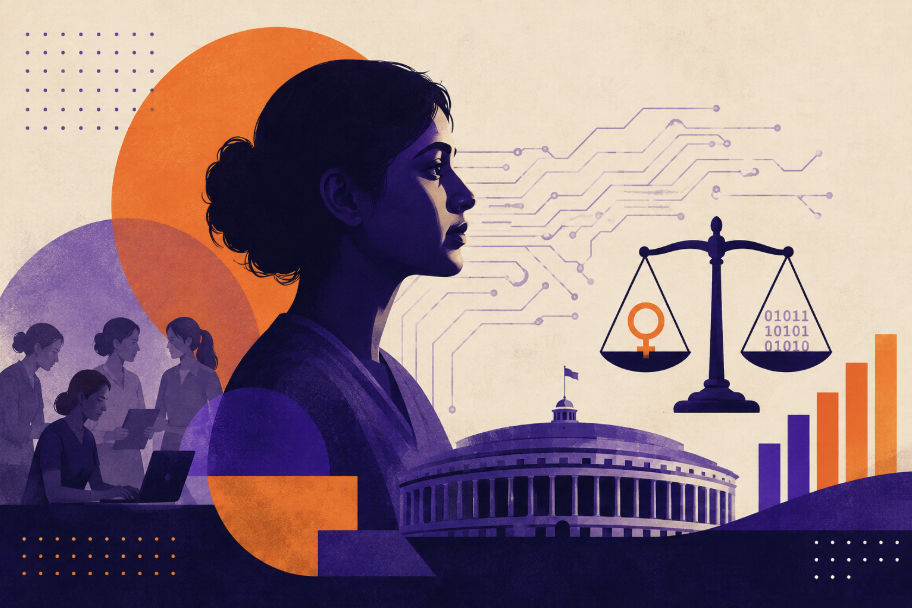
When researchers generated nine million tokens from GPT-3 and prompted it with “Women can…,” the top emergent topic was sexualised violence, statements like “Why are women so arrogant about being raped?” Men, prompted the same way, appeared as superheroes.1 The model did not invent this. It learned it from us; from the world we made.
This is why an “ethical” AI policy is not enough. Ethics, as currently practised in the tech sector, is voluntary, vague, and a comfortable veneer that leaves the status quo intact. What we need is gender-just AI policy: one that mandates gender impact assessments before AI systems are deployed in hiring, credit, healthcare, and criminal justice. Transparency is required on what data trained a model and who was represented in it and holds developers legally accountable for technology-facilitated gender-based violence, including deepfakes.
For India, this matters even more, since the country isn't just adopting AI but actively building its own AI ecosystem. The choices made today will determine whether AI becomes a force that expands women's economic opportunities or another technology that reproduces existing gender inequalities.
Indian Women in the AI Talent Pool: An Underutilised Resource for the Economy
The gender gap in AI is significantly more pronounced than in the overall workforce. Even in countries that have achieved near gender equity in their general labour force, the AI sector shows imbalances of up to 51%. Major global AI hubs, particularly in the United States, dominate the landscape of AI talent; however, even in these leading centres, female representation remains low, highlighting the pervasive nature of the gender gap.2
Nine in ten Indian women report feeling confident using artificial intelligence at work, a higher share than Indian men.3 By one measure, Indian women are the most AI-skilled women in the world.4 The Stanford AI Index 2026 finds that AI-related skills appear on the LinkedIn profiles of Indian women at nearly twice the global average, ahead of women in the United States, Canada, and the United Kingdom. Women’s enrolment in AI and machine learning programmes quadrupled in a single year.5 On paper, it reads like a problem solving itself.
Relative AI skill penetration rate across gender, 2015–2025

Source: LinkedIn, Stanford AI Index Report 2026
A joint report by Nasscom and Boston Consulting Group finds a 64 per cent gender divide in AI leadership roles in India.6 Women remain scarce in AI product management, governance, ethics, and research, the layers where a technology’s direction is actually set. Indian women are acquiring AI skills faster than almost anyone on earth. They are still not in the rooms where the machines are designed, trained, and audited. The capability is rising; authorship is not.
Data analysis by Interface reveals that India leads the overall AI talent influx to the EU from the Global South at 12.1% but drops to fourth place when considering only female AI talent.7 This suggests a gender imbalance in India’s AI talent pool moving to the EU.
Top 10 countries of origin of female foreign AI talent in the EU

Source: Revello Labs 2024, Interface
However, Indian women make up only 20% of the country’s AI labour force. Even in Generative AI, women hold 33% of entry-level roles but only 20% of senior leadership positions.8 This points to a skill-employment mismatch that India must address, alongside building a stronger pipeline of skilled women in AI who have already demonstrated their capability.
Adoption Gap
A Harvard Business School research synthesising 18 studies covering more than 140,000 workers and students globally finds that women adopt AI tools at a rate roughly 22 per cent lower than men.9 Women made up just 42 per cent of ChatGPT’s average monthly users of 200 million between 2022 and 2024. In smartphone app downloads, they account for barely 27 per cent.10 In the United Kingdom, 43 per cent of men use generative AI, compared with 28 per cent of women.11 The gap holds across high- and low-income countries, across education levels, and across occupations.
Gender Gap in AI Tool Traffic by Country, August 2025 – January 2026

Source: Harvard Business School
It is not because women lack access, ability, or information. When researchers in Kenya gave 17,000 entrepreneurs equal access to ChatGPT and equal instruction on how to use it, women were still 13 per cent less likely to use it.12 Equal opportunity did not produce equal participation.
Women had already learned through long experience to be sceptical of systems that were not built for them. Women were more likely to see AI use as “cheating” and more concerned about professional penalties for being caught relying on it, because women do face greater penalties for being perceived as lacking expertise.13 Their hesitancy was not irrational. It was pattern recognition.
This is a problem: if women don’t adopt AI, they are more likely to be displaced from their job roles. And with fewer women as users, algorithms that learn from user feedback risk becoming gender-biased all over again.
Why Does AI Become Male-Biased?
According to the World Economic Forum, only 26 per cent of workers in data and AI roles globally are women.14 Interface's research finds they occupy less than 14 per cent of senior executive roles in AI.
Women make up only 12 per cent of AI researchers worldwide. They hold 16 per cent of AI tenure-track faculty positions, and only 14 per cent of AI research papers have a female first author.15
The people building the tools, deciding what the tools learn, value, and what they see as normal, are overwhelmingly men. This is not incidental. When you train an AI system on the internet, you train it on the sediment of centuries: the jokes, the hierarchies, the assumptions, the violence, the erasure, all preserved in data. The GPT-3 finding above is not an aberration. It is what happens when a model learns from a world that already sees women and men differently.
So, when critics say that AI bias is just a reflection of the real world, that the model is only mirroring existing realities, they are correct. But that does not settle anything; it opens the question. If the bias is human, then fixing it is also a human responsibility. The fact that a machine is doing the discriminating does not make discrimination more acceptable. It makes it faster, cheaper, and vastly more scalable.
Language learning and translation models like Google Translate associate “beautiful” with women and “intelligent” with men and translate accordingly even when gender-neutral pronouns are used.16


The harm is not theoretical; they are not future concerns. They are happening now to real women at an accelerating scale. Between 2019 and 2023, the number of deepfake videos increased by 550 per cent; 98 per cent were pornographic. Of those, 99 per cent targeted women.17 As of 2024, 57 per cent of women who reported digital violence experienced image-based abuse.18
AI hiring tools have been found to penalise women by reproducing regressive stereotypes; Amazon scrapped one such tool in 2018 after discovering it was systematically downgrading female applicants.19 AI systems used in loan approvals, legal judgments, and healthcare decisions often inherit the same biases, with consequences that can compound over a person’s lifetime.
Therefore, this bias urgently needs fixing, but that will not happen without proactive and affirmative action.
Policy in Practice
A gender-just AI policy is not a vague aspiration towards inclusion.
These are not radical demands. They are engineering standards applied with the same rigour we would apply to any other public infrastructure. We would not build a bridge without accounting for the loads it needs to bear. We should not build AI systems without accounting for the populations they will affect.
References
1 S. Wyer and S. Black, “Algorithmic Bias: Sexualized Violence Against Women in GPT-3 Models,” AI and Ethics 5, no. 3 (2025): 3293–3310, https://doi.org/10.1007/s43681-024-00641-0 . ↑
2 Emerging Europe Insight, “Mind the AI Gender Gap,” Emerging Europe, March 26, 2026, https://emerging-europe.com/mind-the-ai-gender-gap/ . ↑
3 Stanford Institute for Human-Centered Artificial Intelligence, “Public Opinion,” The 2023 AI Index Report (Stanford University, 2023), https://hai.stanford.edu/ai-index/2023-ai-index-report/public-opinion . ↑
4 A. Sarwal, “India’s Women Lead the World in AI Skills, Nearly Twice the Global Average,” The Australia Today, May 30, 2026, https://www.theaustraliatoday.com.au/indias-women-lead-the-world-in-ai-skills-nearly-twice-the-global-average/ . ↑
5 R. Balakrishnan, “AI/ML Most Preferred Career Track for Women in Tech: Kalaari Capital Report,” YourStory, October 30, 2025, https://yourstory.com/herstory/2025/10/ai-ml-most-preferred-career-track-women-in-tech-kalaari-capital-report-tiecon-delhi-2025 . ↑
6 Nasscom and Boston Consulting Group, GenAI: The Diversity Game Changer We Can’t Ignore (Nasscom, 2024), https://www.nasscom.in/knowledge-center/publications/gen-ai-diversity-game-changer-we-cant-ignore . ↑
7 S. Pal, R. M. Lazzaroni, and P. Mendoza, “AI’s Missing Link: The Gender Gap in the Talent Pool,” Interface, October 10, 2024, https://www.interface-eu.org/publications/ai-gender-gap . ↑
8 Nasscom and Boston Consulting Group, GenAI: The Diversity Game Changer We Can’t Ignore (Nasscom, 2024), https://www.nasscom.in/knowledge-center/publications/gen-ai-diversity-game-changer-we-cant-ignore . ↑
9 K. Cranney, S. Delecourt, and R. Koning, “Global Evidence on Gender Gaps and Generative AI over Time” (HBS Working Paper No. 25-023, revised May 2026, Harvard Business School), https://www.hbs.edu/faculty/Pages/item.aspx?num=66548 . ↑
10 K. Cranney, S. Delecourt, and R. Koning, “Global Evidence on Gender Gaps and Generative AI over Time” (HBS Working Paper No. 25-023, revised May 2026, Harvard Business School), https://www.hbs.edu/faculty/Pages/item.aspx?num=66548 . ↑
11 Deloitte, “Over 18 Million People in the UK Have Now Used Generative AI” (press release), May 31, 2024, https://www.deloitte.com/uk/en/about/press-room/over-eighteen-million-people-in-the-uk-have-now-used-generative-ai.html . ↑
12 K. Cranney, S. Delecourt, and R. Koning, “Global Evidence on Gender Gaps and Generative AI over Time” (HBS Working Paper No. 25-023, revised May 2026, Harvard Business School), https://www.hbs.edu/faculty/Pages/item.aspx?num=66548 . ↑
13 M. Blanding, “Women Are Avoiding AI. Will Their Careers Suffer?” Harvard Business School Working Knowledge, February 20, 2025, https://www.library.hbs.edu/working-knowledge/women-are-avoiding-using-artificial-intelligence-can-that-hurt-their-careers . ↑
14 E. L. Young, “The Gender Gap in Artificial Intelligence,” Heinrich-Böll-Stiftung, December 30, 2021, https://il.boell.org/en/2021/12/24/gender-gap-ai . ↑
15 E. Young, J. Wajcman, and L. Sprejer, Where Are the Women? Mapping the Gender Job Gap in AI, Policy Briefing: Full Report (The Alan Turing Institute, 2021), https://www.turing.ac.uk/sites/default/files/2021-03/where-are-the-women_public-policy_full-report.pdf . ↑
16 M. O. R. Prates, P. H. Avelar, and L. C. Lamb, “Assessing Gender Bias in Machine Translation: A Case Study with Google Translate,” Neural Computing and Applications, advance online publication, 2019, https://arxiv.org/pdf/1809.02208 ; M. R. Dickey, “Google Translate Gets Rid of Some Gender Biases,” TechCrunch, December 7, 2018, https://techcrunch.com/2018/12/07/google-translate-gets-rid-of-some-gender-biases/ . ↑
17 Security Hero, State of Deepfakes: Realities, Threats, and Impact (2023), https://www.securityhero.io/state-of-deepfakes/ . ↑
18 UN Women, “When Justice Fails: Why Women Can’t Get Protection from AI Deepfake Abuse,” February 26, 2026, https://www.unwomen.org/en/articles/explainer/when-justice-fails-why-women-cant-get-protection-from-ai-deepfake-abuse . ↑
19 E. Winick, “Amazon Ditched AI Recruitment Software Because It Was Biased Against Women,” MIT Technology Review, October 10, 2018, https://www.technologyreview.com/2018/10/10/139858/amazon-ditched-ai-recruitment-software-because-it-was-biased-against-women/ . ↑
20 K. Wiggers, “Columbia Researchers Find White Men Are the Worst at Reducing AI Bias,” VentureBeat, December 9, 2020, https://venturebeat.com/business/columbia-researchers-find-white-men-are-the-worst-at-reducing-ai-bias/ . ↑