


IIM Bangalore (BBA DBE)
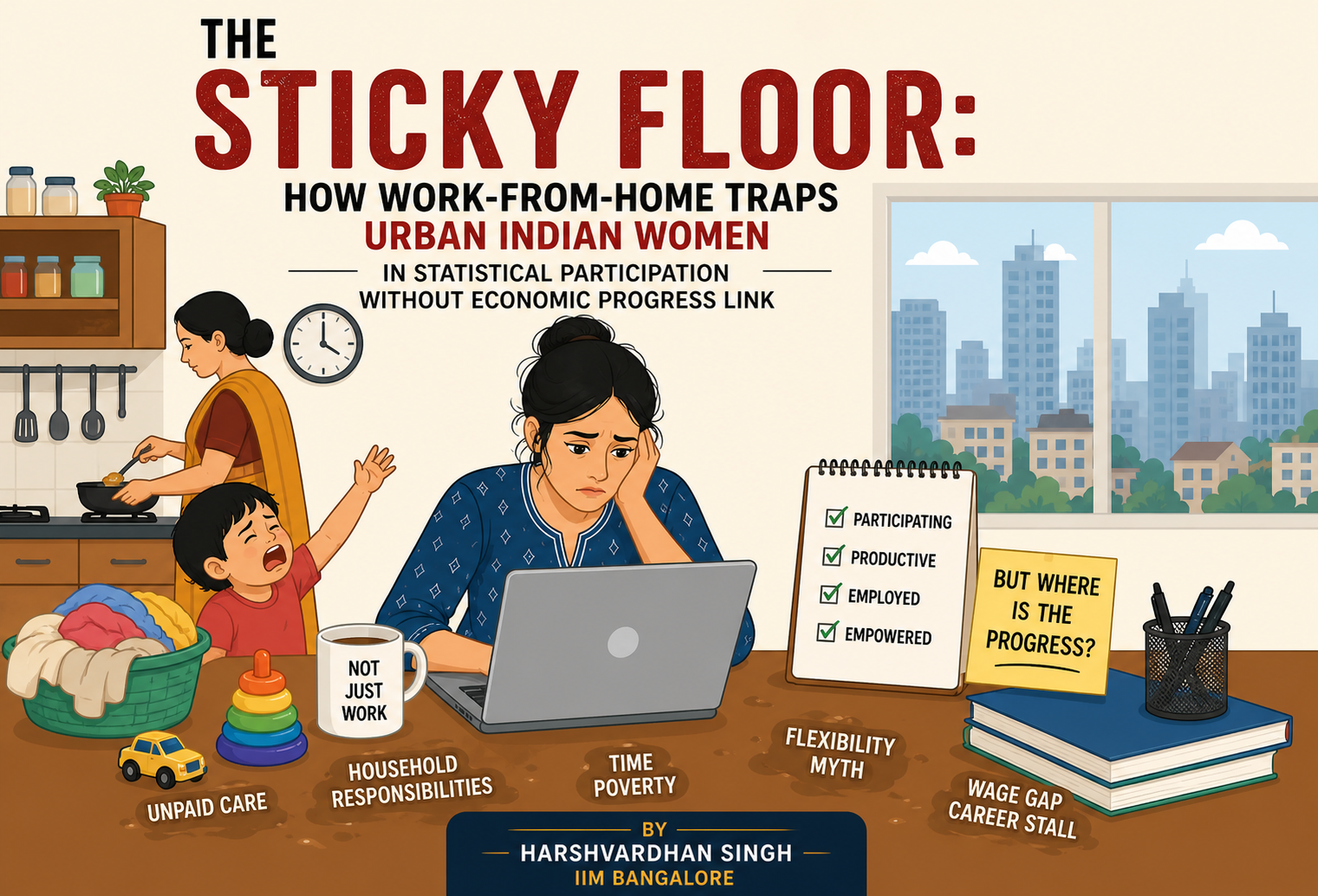
In 2024, researchers gave 3,200 married women in Mumbai a choice: work from home on your schedule, or take the same job at an office. Fifty-six percent took the WFH role; only 27 percent took the office job (Jalota & Ho, 2024). The difference was not the work. It was where it happened. Work-from-home works. Not as a lifestyle upgrade but as the only entry point many urban Indian women are actually permitted to take. A husband’s objection, a safety concern, no childcare: WFH sidesteps all of it in ways no government programme has managed. And yet India’s urban female labour force participation rate (FLFPR) sits at 27.6 percent in 2023–24, up from 20.4 percent in 2017–18 (Ministry of Statistics and Programme Implementation, 2024; Planning and Economic Policy Division, EAC-PM, 2024). This analysis covers three arrangements: formal telework, gig-platform work, and home-based piecework, each with different policy problems. It borrows the sticky floor concept from Booth et al. (2003), originally describing wage immobility at the distribution’s lower end, and applies it to participation itself.
May, 2026