


Jul, 2026
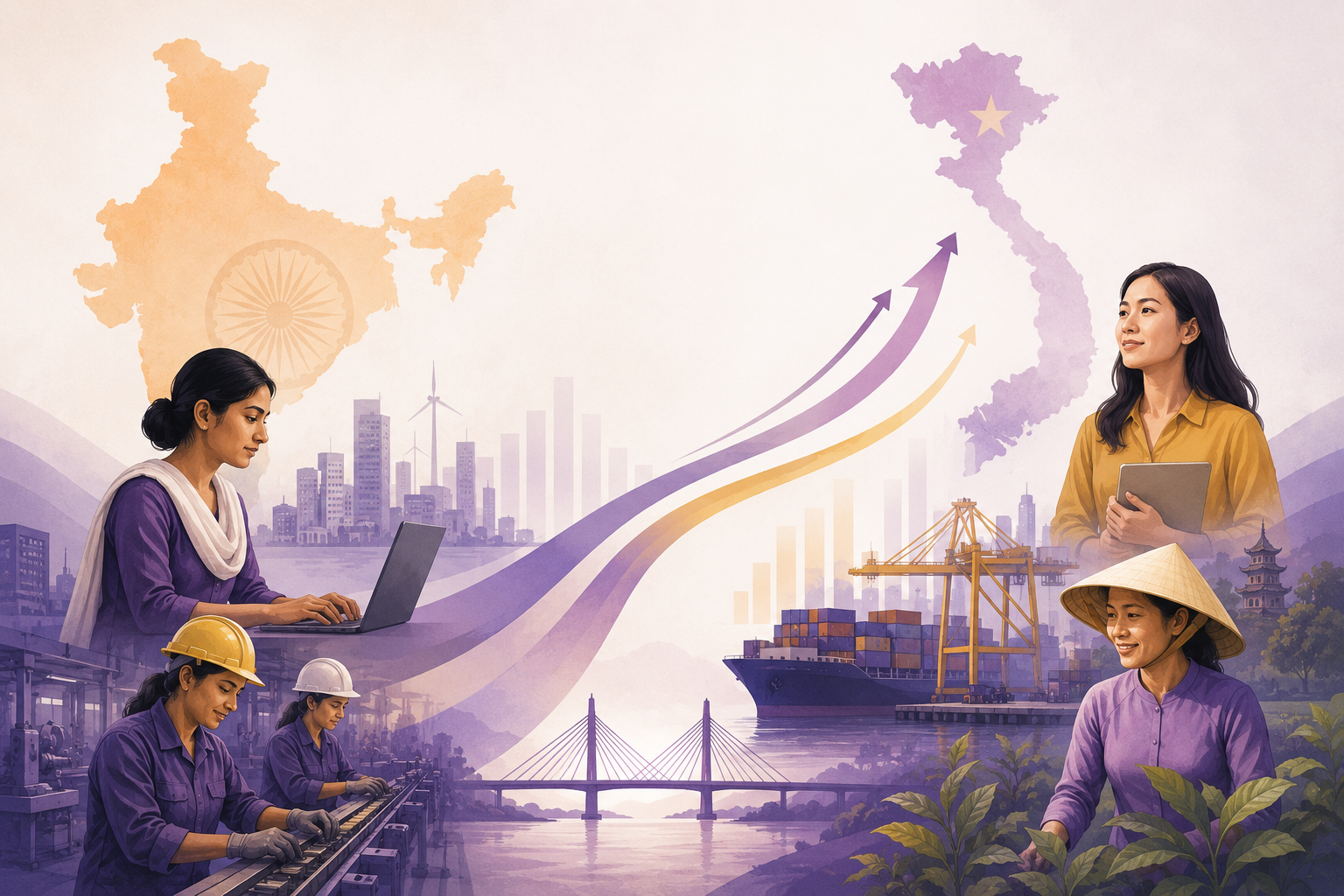
At first glance, India and Vietnam appear to have followed very different historical and cultural trajectories. Yet, from an economic perspective, the two countries are often grouped as high-performing emerging markets. Both embarked on market-oriented reforms around the same period, integrated themselves into global value chains, and have sustained similar GDP growth metrics for most of the last two decades.
Vietnam's female labour force participation rate hovers around 68%. India's sits at roughly 42%, a gap that isn't a rounding error or a quirk of measurement. Nearly a third of India's working-age women are simply missing from the labour force when set against Vietnam's numbers, and that kind of gap doesn't happen by accident. It comes down to how each country's growth was structured, how labour-intensive its industrialisation actually was, and whether the policy environment made room for women to work in the first place.
Understanding why these two economies, despite similar macroeconomic trajectories, have produced such different outcomes for women offers valuable insights. Vietnam's development model could especially provide some lessons for India, as it seeks to accelerate women's meaningful economic participation needed for becoming a developed economy.
Figure 1: Vietnam sustains 68–73% across the period. India falls from approximately 30% in 2000 to around 20% by 2017–18, before recovering to approximately 33–34% by 2025
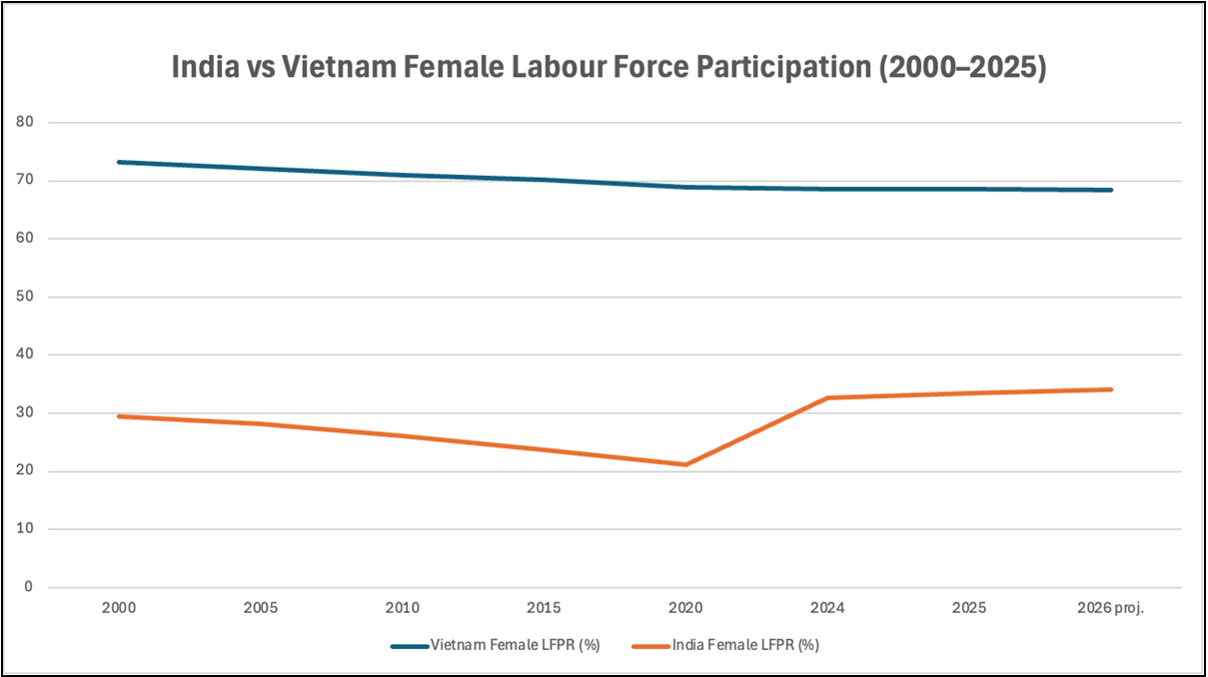
Sources: World Bank , PLFS, MoSPI
Vietnam’s Economic Transformation and the Rise of Women’s Labour Force Participation
While it may be tempting to attribute the stark difference in female labour force participation between India and Vietnam to culture or historical legacy, Vietnam’s experience challenges this assumption. Very similar to India, Vietnam has long grappled with patriarchal social norms, unequal distribution of unpaid care and domestic work, and persistent gender stereotypes. And yet Vietnamese women kept working anyway, moving through wave after wave of economic restructuring without dropping out of the labour force the way theory might predict.
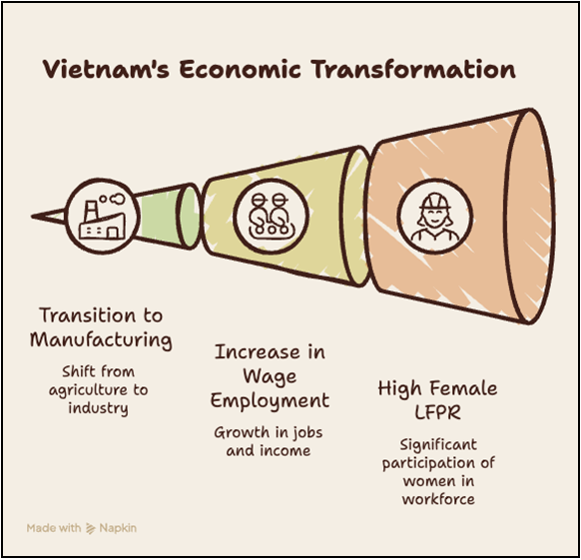
Much of that traces back to 1986, when the Đổi Mới reforms pulled Vietnam out of central planning and into what its architects called a socialist-oriented market economy. The reforms liberalised trade, encouraged private enterprise, dismantled collective farming in favour of household agriculture, and actively welcomed foreign direct investment. Over the next three decades, Vietnam emerged as a global manufacturing hub for electronics, garments, footwear, furniture and other export-oriented industries.
Figure 2: Agriculture falls from approximately 65% of employment in 2000 to 27–28% by 2026. Industry rises from 13% to 33%. Services from 22% to 39–40%.
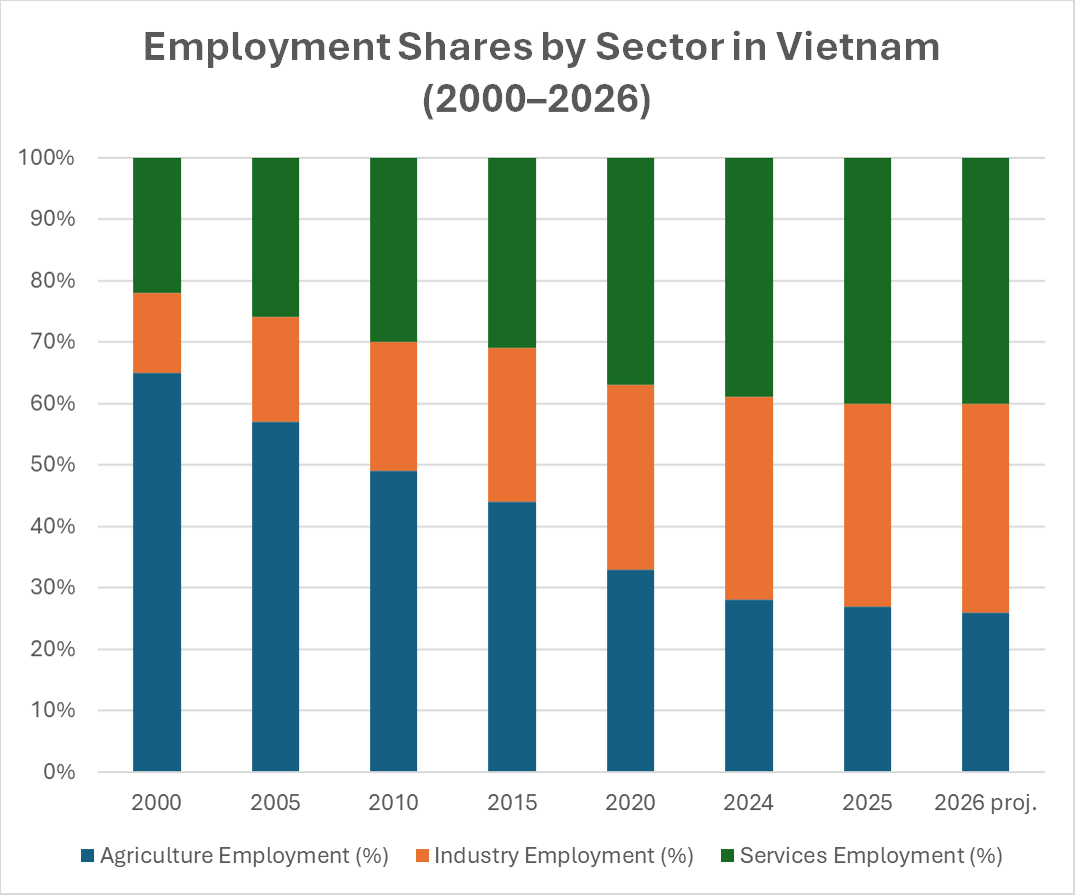
Source: World Bank- Agriculture , Industry, Services
Crucially, this model of industrialisation was labour-intensive by design. Export manufacturing created millions of jobs requiring relatively low levels of formal education but high levels of dexterity and discipline—characteristics that employers often associated with female workers. Young women from rural households migrated in large numbers to industrial clusters around Hanoi, Ho Chi Minh City and other manufacturing centres, where factory employment offered wages significantly higher than subsistence agriculture. For many, paid employment translated into financial independence, the ability to remit income to their families, delayed marriage, and greater bargaining power within the household.
However, labour demand alone did not explain Vietnam’s success. The country's socialist legacy had already normalised women's participation in productive work decades before the
manufacturing boom. During the post-war reconstruction period, women played an integral role in agricultural production, cooperatives and the public sector, reinforcing the idea that women's economic contribution was both necessary and socially legitimate. As a result, when multinational firms began relocating production to Vietnam during the 1990s and 2000s, they encountered a workforce in which women's wage employment was already culturally accepted rather than socially contested.
Vietnam’s experience therefore reflects the interaction of two reinforcing forces. On the demand side, export-led industrialisation generated large-scale employment opportunities that actively absorbed female labour. On the supply side, pre-existing institutional norms and state policies had already legitimised women's participation in paid work, enabling women to respond to these new economic opportunities. The convergence of favourable labour demand and supportive social institutions allowed female employment to expand at a scale rarely observed in other developing economies.
manufacturing boom. During the post-war reconstruction period, women played an integral role in agricultural production, cooperatives and the public sector, reinforcing the idea that women's economic contribution was both necessary and socially legitimate. As a result, when multinational firms began relocating production to Vietnam during the 1990s and 2000s, they encountered a workforce in which women's wage employment was already culturally accepted rather than socially contested.
Vietnam’s experience therefore reflects the interaction of two reinforcing forces. On the demand side, export-led industrialisation generated large-scale employment opportunities that actively absorbed female labour. On the supply side, pre-existing institutional norms and state policies had already legitimised women's participation in paid work, enabling women to respond to these new economic opportunities. The convergence of favourable labour demand and supportive social institutions allowed female employment to expand at a scale rarely observed in other developing economies.
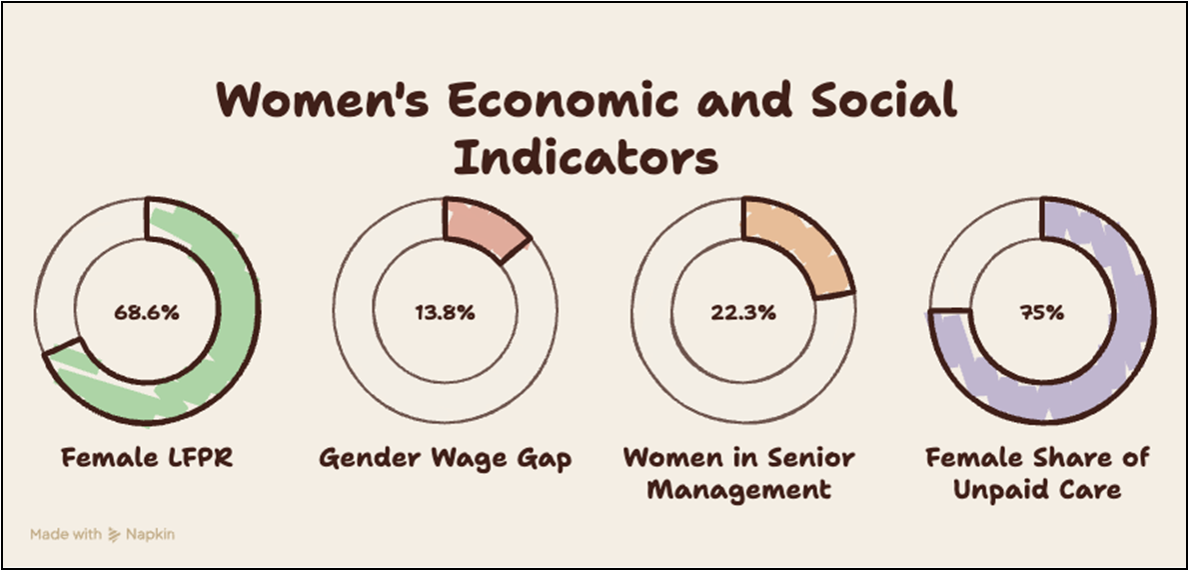
Figure 3: Vietnam female LFPR (strong, ~68.6%) vs gender wage gap (~13.8%) vs women in senior management (~22.3%) vs female share of unpaid care hours (~75%).
Comparing Vietnam’s Experience to India
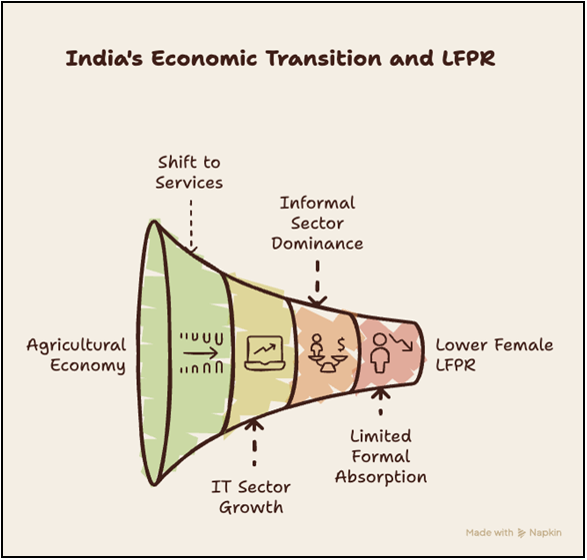
Over the same period, India also experienced one of the fastest periods of economic expansion in the developing world. The divergence with Vietnam, therefore, lies not in the pace of growth, but in its composition. India's growth was concentrated in relatively skill-intensive sectors that generated employment for a narrow segment of the labour force.
In contrast to Vietnam's development model, India never experienced the large-scale expansion of labour-intensive manufacturing . The absence of a vibrant manufacturing sector in India, capable of absorbing millions of semi-skilled workers, meant that women had relatively few pathways into formal wage employment. Even today, women account for only around 12 per cent of manufacturing employment in India, compared with approximately 31 per cent in Vietnam.
The challenge extends beyond industrial structure. Infrastructure matters just as much here as policy does. Whether a woman can actually take a job often comes down to whether she can get there safely, afford to live near it, or count on any planning logic behind how the city around her has grown, and on all three counts, Indian industrialisation has fallen short. Vietnam's export-oriented industrial corridors, by comparison, were developed with greater spatial concentration of jobs and supporting infrastructure, making female migration for factory work both economically viable and socially acceptable.
Childcare further reinforces this structural constraint. Without childcare she can actually afford or reach, a woman is often left choosing between a paycheque and her children, and that's not really a choice at all. Where stable formal employment is unavailable, many opt to withdraw from the labour market altogether. Vietnam has not fully resolved this challenge, but two specific interventions show how it has treated childcare as infrastructure rather than a private family cost. The first is bán trú, a near-universal model of full-day schooling in which children remain at school from roughly 7:30 a.m. to 5 p.m., with lunch, a supervised rest period, and after-school activity built into the regular school day. Unlike India's single-shift school day, which typically ends by early afternoon and requires a parent, who is almost always the mother, to be available for midday pickup and supervision, bán trú stretches the length of the school day to match the length of a standard factory or office shift. Critically, it does not require a parallel childcare system to be built from scratch; it repurposes school infrastructure that already reaches nearly
every child. The second is the financing of maternity leave itself: Vietnam's six months of paid leave is funded through the compulsory social insurance fund, not billed directly to the employer. This distinction matters more than the duration. Since the cost is pooled across all employers rather than concentrated on the one hiring the woman, it removes the direct payroll incentive to avoid hiring or promoting women of childbearing age. A disincentive that persists in India, where maternity benefit costs largely fall on the individual employer under the Maternity Benefit Act.
At the same time, Vietnam's experience should not be viewed as an unqualified success. Although women participate in the labour force at much higher rates than in India, they remain concentrated in lower-value segments of manufacturing and services, with limited representation in supervisory, managerial and technology-intensive occupations. Gender wage gaps persist and widen at higher occupational levels, while women's representation in corporate leadership remains modest. Moreover, the very assembly-line jobs that enabled Vietnam's female employment revolution are among those most vulnerable to automation and technological upgrading.
Vietnam has therefore largely addressed the challenge of women's labour force participation; its next frontier is ensuring that women move up the value chain as the economy itself advances. India's challenge, by contrast, is to first create an economic structure that generates large-scale employment opportunities for women, while simultaneously investing in care, transport, safety, and urban infrastructure that enable their participation in the workforce.
Figure 4: Comparing India and Vietnam’s Economic Transformation
What India Can Take Away from Vietnam
The comparison with Vietnam underscores the fact that women's economic participation is not an automatic outcome of growth. It is the result of deliberate policy choices that shape both the demand for women's labour and their ability to participate in the workforce. Five specific Vietnamese policies stand out as candidates India could pilot at the state level-
Bibliography
https://www.ilo.org/sites/default/files/2024-08/India%20Employment%20-%20web_8%20April.pdf https://www.oecd.org/en/publications/oecd-economic-surveys-viet-nam-2025_fb37254b-en/full-report/towards-more-inclusive-growth_0f09c63a.html
https://www.ncbi.nlm.nih.gov/pmc/articles/PMC9031189/
https://www.worldbank.org/en/news/press-release/2025/03/12/viet-nam-s-economy-forecast-to-grow-6-8-percent-in-2025-wb
https://www.dataforindia.com/women-in-manufacturing/
https://vietnamlawmagazine.vn/roles-performance-and-contributions-of-women-representatives-during-the-2016-21-period-and-implications-for-gender-equity-in-elected-bodies-in-vietnam-37982.html https://www.nso.gov.vn/en/data-and-statistics/2021/12/gender-equality-in-labor-and-access-to-management-work-in-viet-nam/
https://www.vietnam-briefing.com/news/female-workers-in-vietnam-legal-rights-gender-equality-targets.html/